

Recycling Information, Guidance, Liinks & Outlets
By EHSO.com, the site for free, objective, practical information about the environment, health and safety in 2026!
Recycling Information, Guidance, Liinks & Outlets
Recycling Information, Guidance, Liinks & Outlets

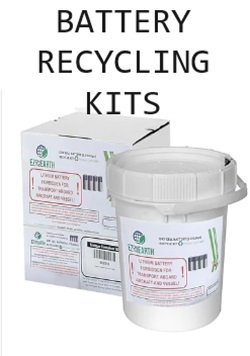
You might also like these convenient all-in-one battery recycling collection containers. There good for home or business. They're obvious and clear, no explanation required. It has everything you need, Everything you need to easily and safely recycle batteries: an attractive box, instructions, a roll of tape, required labels, and a D.O.T. Special Permit.
- Batteries - Lead acid, NiCd, Etc.
- Fluorescent Lights Information Page
- Fluorescent Lamp & Ballast Recycling Services
- Mercury Recyclers

&URL=https%3A%2F%2Fenvirosystemsinc.com/_vti_bin/shtml.dll/recyclables.html/map1)
Recycling Obscure Materials
Simple instructions are given on recycling computer floppy discs, computers, eyeglasses, smoke detectors, Styrofoam packing, compact discs, cameras, holiday cards, batteries, household goods, sneakers and synthetic carpets.
Computer floppy disks & unsold software, Reuse / Recycling
 Several processors now recycle computer floppy disks. Unsold software is disassembled and separated into paper, plastic and disks. The disks, with are effectively brand new, are erased, formatted, tested, labeled, and reused. GreenDisk of Redmond Washington sells reclaimed disks as GreenDisk Recycled Diskettes. Individuals and companies may also send old or defective disks directly to the company which will shred the disks and recycle the plastic and metal. For more information, link to
GreenDisk, Inc..
Several processors now recycle computer floppy disks. Unsold software is disassembled and separated into paper, plastic and disks. The disks, with are effectively brand new, are erased, formatted, tested, labeled, and reused. GreenDisk of Redmond Washington sells reclaimed disks as GreenDisk Recycled Diskettes. Individuals and companies may also send old or defective disks directly to the company which will shred the disks and recycle the plastic and metal. For more information, link to
GreenDisk, Inc..
Of course disks are fully reusable. Removable labels are rare on disks, but stacking two labels is usually OK. For the top label, select the type that does not wrap over the top of the disk. To clear all old data and even viruses from a floppy you just need to do a "full" or "unconditional" disk format -- Macintosh: Use initialize from the finder. Windows 3.1/DOS: From a DOS prompt type "format a: /u". Windows 95: Right-click on the drive icon and select format. Select "full" format. Your disk will be checked fully for errors and work as good as new.
Computers, Reuse / Recycling
A view good national list of computer donation and recycling organizations can be found at the PEP National Directory of Computer Recycling Programs. Donate or recycle your old computers before they become totally obsolete!
Eyeglasses, Reuse / Recycling
 The old lenses that steer you into walls may be the perfect gift for someone in need. Chances are an optician or club in your area collects eyeglasses for reuse. Collected eyeglasses are cleaned, repaired and measured to determine the correction. Available glasses are cataloged in a computer database, and matched to people with need. Many of the glasses are sent to other countries, as laws in the USA make it difficult to re-dispense a prescription product. Another option is to have your old glasses tinted to turn them into sunglasses.
The Lions Clubs operate the largest program, collecting glasses from thousands of opticians. Of the chain stores, LensCrafters, For-Eyes and Pearle collect glasses chain-wide. Several organizations accept eyewear by mail. Collect glasses from friends and co-workers and use a box to pack the eyewear so it won't be damaged. Send by third class, fourth class or UPS ground.
Medical Ministry International, ATTN: eyeglass recycling, 12281 S.W. 28th, Miami, FL. 33175 accepts reusable eyewear of all types. SightFirst Eyeglass Recycling Center, 34 W. Spain, Sonoma, CA 95476 accepts all types of glasses for the Lion's program. New Eyes for the Needy, 549 Millburn, PO Box 332, Short Hills, NY 07078 accepts scrap metal frames in any condition, unbroken plastic framed glasses, non-prescription sunglasses and any precious metal scrap like broken jewelry. In Canada send glasses to The Low Vision Clinic, 1929 Bayview Ave., Toronto, ON M4G 3E8.
Polystyrene Packing & Peanuts, Reuse
 Those pesky packing peanuts don't have much recycling potential, but they can be reused, which is even better. Many packing, shipping and moving stores will take used peanuts. Just pack them up in (recycled) plastic bags, and drop them off next time you are nearby. Suitable businesses can be located under "packaging" in the yellow pages. Typical chain stores include Mail Boxes Etc. and The Postal Annex. For a partial list of local collection sites, try the Plastic Loosefill Council at 1-800-828-2214 (24 Hours).
Some peanuts are not made of plastic. If you find a peanut that looks like a cheese puff, try licking it. One type of peanut is made from vegetable starch, and dissolves almost instantly in water. These taste somewhat like rice cakes, and are just as safe in a compost bin.
Disposal of large expanded polystyrene blocks (such as those protecting new equipment) is problematic. The materials are very lightweight and take little energy to produce: it is easy to end up with a net environmental loss just transporting the stuff. For most individuals recycling this material is not worth it, though future research into local small-scale reprocessing may change this. If you have large quantities of material, a list of collection sites is available from The Alliance of Foam Packaging Recyclers.
Compact Discs (CD's), Repair/Reuse/Recycling
Damaged CD's can be repaired, and repair or reuse is definitely a better environmental option than recycling. You have some chance of repairing small numbers of obvious scratches with a mild abrasive such as toothpaste. Work only on the non-label side, with strokes radially out from the center. Professional refinishers such as AuralTech CD Refinishing will repair disks for about $3 each and guarantee the results.
If you just don't like the CD's, trade them in at a music store or donate them to charity. Obsolete or unrepairable CD's can be recycled. Music, CD-ROM and even write-once disks are all ok. Booklets and paper backings are ok, but are better recycled as mixed paper. Do not include any material other than CD's, jewel boxes and incidental paper.
If you are worried about proprietary data on the discs, you can cut them with a pair of heavy duty tin shears, or place them in a microwave oven with a small glass of water (for one disc, 5 seconds on high does a fantastic job, and creates a spectacular light show). Cases and CD's are pelletized: cases end up as (generally non-recyclable) egg cartons, CD's end up as automotive parts.
Send pre-paid by UPS Ground, third-class mail, freight or other surface transportation to Plastic Recycling Incorporated, 2015 South Pennsylvania, Indianapolis, IN 46225. 317-780-6100.
Smoke Detectors, Proper Disposal
 The most common type of smoke detector contains a small amount of Americium 241, a radioactive material. On your wall this presents little threat. When broken open in an incinerator or landfill, the material can pose a health hazard. For this reason all detectors must, by law, be labeled as to radioactive content. Detector companies accept returned radioactive detectors for disposal as hazardous waste. Unfortunately the companies seem to assume you'll keep the instruction booklet on hand for the entire life of the product, and don't always put good contact information on the case.
Detectors have a limited life span, usually specified at ten years. Testing your detector with actual smoke is the only way to be sure it will work when needed. The vast majority of smoke detectors are made by First Alert Corporation. Send old detectors to First Alert, Radioactive Waste Disposal, 780 McClure Rd, Aurora, IL 60504-2495, 1-800-323-9005. Others are made by a Canadian firm called American Sensors, dial 1-800-387-4219 for information. The companies sell detectors under many different brand names, and can dispose of any of them. Send detectors by surface mail or UPS Ground so they don't end up in an airplane.
Disposable single use cameras, Recycling
Recent studies have show that, despite the recycling claims on the boxes, less than half of disposable cameras are ever actually recycled. Enough cameras have been tossed to circle the planet, stacked end-to-end. Local film developers often have little or no incentive to return the camera bodies to the manufacturers, and not all parts of the cameras are recyclable. Kodak has started to minimally reimburse developers for the costs of sorting, storing and shipping, but processors are still faced with a bewildering variety of types, brands, and procedures for dealing with them.
Inexpensive fully-automatic 35mm cameras can be purchased for about $20 if you look carefully. These cameras will give better results and cost less to use than the disposables. If you must use a disposable camera, be sure to take it to a developer that explicitly promises to recycle the remains.
Holiday Cards, Reuse
 For the last 25 years Saint Jude's Ranch, a non-profit youth home, has operated a holiday card reuse program. The ranch provides counseling and opportunities for troubled youth. The kids operate a business taking used greeting cards, neatly cutting off the front covers, gluing on new back covers, and selling the result. The kids earn money, experience and a sense of purpose.
You send either entire cards, or cards with the backs cut off. Send bundles of cards via UPS ground or the "bound printed matter" rate at the post office. St. Jude's Card Recycling, 100 St. Jude Street, Post Office Box 60100, Boulder City, NV 89006.
Batteries (dry-cell, rechargeable, automotive, button, lead-acid)
Battery technology is becoming increasingly important with the rise of portable computing, remote data monitoring and electric vehicle research. Unfortunately batteries contain metals, acids and other compounds that can be bad when released into the environment. Here's how to recycle the most common battery types:
Alkaline & Carbon-Zinc ("Heavy Duty") dry cell batteries, Disposal
Consumers in the USA have few options for these types of batteries. The experts recommend individuals place these with normal household trash, unless your trash is incinerated or you are restricted by local regulations. Some communities collect batteries as part of a recycling program, but the batteries generally end up in a hazardous waste landfill. Several reclamation companies are now processing these batteries, so the situation may improve soon.
Rechargeable batteries provide the only alternative. Ni-Cd batteries may be recharged many times, but have much less capacity than alkalines. Rayovac sells a line of reusable alkaline batteries called "Renewal", which have a large fraction of the capacity of a regular alkaline, but only last for 25 or so charges. Do not send any type of dry cell battery to facilities designed to recycle other rechargeables.
Nickel-Cadmium batteries, Recycling
Nicad rechargeable batteries can be recycled, and it is important to do so because of the toxic metal cadmium contained in the batteries. See the companion guide to common materials for the details.
Nickel Metal Hydride (NiMH), Recycling
Lithium Ion (Li-Ion), Recycling
Many newer laptop computers and other portable use Nickel Metal Hydride or Lithium-Ion batteries. Battery retailer Power Express will accept reasonable numbers of batteries by surface mail or UPS Ground for recycling. Package to prevent electrical short circuits and send to: Power Express Batteries, ATTN: Battery Recycling, 14388 Union Avenue, San Jose, CA 95124 (USA).
Button Cell Batteries, Recycling / Proper Disposal
Most small, round "button cell" type batteries contain mercury, silver, cadmium, lithium or other heavy metals as their main component. These materials leak in landfills, can enter the water table, and are even worse when incinerated. Button Cells are increasingly targeted for recycling because of the value of recoverable materials, the hazard to the environment, and the small size and easy handling relative to other battery types.
Many shops that replace watch and hearing aid batteries will accept your batteries for recycling at no charge. Check with a jeweler, watchmaker, or volume retailer like Pay-less or K-Mart. If you have your watch batteries replaced, be sure to ask if the battery will be recycled.
Stores & repair shops can purchase plastic-lined collection/shipping containers from MERECO 1218 Central Ave, Albany NY 12205 1-800-833-3505. Believe it or not, the batteries are sorted by part numbers looked up in a reference guide. Obviously a better type marking system is needed, and perhaps one that allows batteries to be sorted by machine.
Automotive batteries, Recycling
Automotive batteries contain lead. Lead is both toxic and valuable; in the US over 95% of all automotive batteries are recovered and recycled. Virtually any place that sells batteries will take them back, most state laws require it. Unfortunately many batteries are sent to overseas smelters with poor environmental and worker health records; you might ask where your battery will be sent. Domestic recycler EXIDE has a good reputation.
Non-automotive lead-based batteries (Gel Cells, SLA, etc), Recycling
Gel cells and sealed lead-acid batteries are commonly used in industrial equipment, emergency lighting, and alarm systems. The same recycling process applies as with automotive batteries, but not all retailers will understand this. An automotive store may accept the batteries, you can try a security dealer, The Battery Council International at (312) 664-6610, or your local waste agency.
Good resources for comparison, care and feeding of batteries are Cadex Electronics, the IBET Rechargeable Battery Tutorial and NiCad Ramblings.
Unwanted Household Goods (small appliances, tableware, clothing, furniture, toys, sports equipment, children's books, white elephants, etc.)
 Your unwanted household items can have a life again if you donate them to charity. Organizations such as
Goodwill Industries will take your donations, sort and sometimes repair them, and resell them in thrift shops nationwide. Broken items are fixed, and scrap materials (like worn-out textiles) are sold for recycling. Goodwill provides jobs and job training for tens of thousands of people who would otherwise have trouble finding work. In 1994 alone Goodwill assisted 25,000 people finding placement in the private sector, helping many people get off public assistance. Wash the clothing, and try to include manuals or brochures on appliances (especially if broken). Surf the net, scan the white pages or look in the yellow pages under "Thrift Shops" for a charity and drop-off center near you.
Your unwanted household items can have a life again if you donate them to charity. Organizations such as
Goodwill Industries will take your donations, sort and sometimes repair them, and resell them in thrift shops nationwide. Broken items are fixed, and scrap materials (like worn-out textiles) are sold for recycling. Goodwill provides jobs and job training for tens of thousands of people who would otherwise have trouble finding work. In 1994 alone Goodwill assisted 25,000 people finding placement in the private sector, helping many people get off public assistance. Wash the clothing, and try to include manuals or brochures on appliances (especially if broken). Surf the net, scan the white pages or look in the yellow pages under "Thrift Shops" for a charity and drop-off center near you.
Sneakers & Athletic Shoes, Recycling
 Nike corporation grinds up shoes and reuses some of the components for athletic mats, which are donated to good causes. Call 1-800-352-NIKE and navigate deep into the menu for drop-off locations and a Reuse-A-Shoe program description. Next time you buy shoes, ask the store if they participate in any recycling programs.
Carpets, Synthetic, Recycling
Old synthetic carpets have value as recycled materials. Individual consumers generally can't get rid of a carpet, but you can ask installers and renovation companies if they will do it for you. See the pages of United Recycling Incorporated, The Partnership for Carpet Reclamation (Actually just DuPont) or AlliedSignal's Carpet Recycling Information Page for the details.
Ways to save money AND help the environment:
Save water AND money with this showerhead adapter, it lets the water flow until the water is hot, then shuts off water flow until you restart it, ShowerStart TSV Hot Water Standby Adapter
Eat healthier AND save money: Instant Pot Duo 7-in-1 Electric 8 QT Pressure Cooker, Slow Cooker, Rice Cooker, Steamer, Sauté, Yogurt Maker, Warmer, Sterilizer, Pot is Stainless Steel

Protect your health with these:
Mattress Dust mite-Bedbug protector, 100% Waterproof, Hypoallergenic, Zippered
Handheld Allergen Vacuum Cleaner with UV Sanitizing for Allergies and Pet, Kills Mite, Virus, Molds, True HEPA with Powerful Suction removes Hair, Dander, Pollen, Dust ,
,
Immune Support Supplement with Quercetin, Vitamin C, Zinc, Vitamin D3
GermGuardian Air Purifier with UV-C Light and HEPA 13 Filter, R emoves 99.97% of Pollutants
HEPA Air Purifier, HEPA Air Cleaner with Washable Pre-Filter, AQI Display, ECO Mode, Sleep Mode, Pet Mode for Pets, Dust, Pollen, Removes 99.97% of Particles, Smoke, Mold, Pet Dander, Dust, Odors
Interesting Reads:
THE PREPPER'S CANNING & PRESERVING BIBLE: [13 in 1] Your Path to Food Self-Sufficiency. Canning, Dehydrating, Fermenting, Pickling & More, Plus The Food Preservation Calendar for a Sustainable Pantry
The Backyard Homestead: Produce all the food you need on just a quarter acre! P aperback
The Citizens' Guide to Geologic Hazards: A Guide to Understanding Geologic Hazards Including Asbestos, Radon, Swelling Soils, Earthquakes, Volcanoes
The Uninhabitable Earth: Life After Warming
Book: The Sixth Extinction:
An Unnatural History Paperback
 .
.