
Table of Contents:
List of Appendices:
Appendix VIII:2-1. Glossary
Appendix VIII:2-2. User Seal Check
Appendix VIII:2-3. Recommended Procedures for Cleaning Respirators
Appendix VIII:2-4. NIOSH Guide to the Selection and Use of Particulate Respirators Certified under 42 CFR 84
A.
Wearing respiratory protective devices to reduce exposure to airborne contaminants is widespread in industry. An estimated 5.0 million workers wear respirators, either occasionally or routinely. Although it is preferred industrial hygiene practice to use engineering controls to reduce contaminant emissions at their source, there are operations where this type of control is not technologically or economically feasible or is otherwise inappropriate.
B.
Since respirators are not as consistently reliable as engineering and work practice controls, and may create additional problems, they are not the preferred method of reducing exposures below the occupational exposure levels. Accordingly, their use as a primary control is restricted to certain circumstances. In those circumstances where engineering and work practice controls cannot be used to reduce airborne contaminants below their occupational exposure levels (e.g., certain maintenance and repair operations, emergencies, or during periods when engineering controls are being installed), the use of respirators could be justified to reduce worker exposure. In other cases, where work practices and engineering controls alone cannot reduce exposure levels to below the occupational exposure level, the use of respirators would be essential for supplemental protection.
C.
There are many variables that affect the degree of protection afforded by respiratory protective devices, and the misuse of respirators can be hazardous to employee safety and health. Selection of the wrong equipment, one of the most frequent errors made in respiratory protection, can result in the employee being exposed to increased concentrations of the harmful contaminant. This error may result in a broad range of health effects caused by the harmful contaminants, including silicosis, asbestosis, permanent lung damage, and cancer. Respirators that are not maintained and inspected can be less effective at reducing exposure to the harmful contaminants, and can place a greater burden on the respiratory system. Respirators that are not clean can cause dermatitis or skin irritation. Because respirator use may give the employee a false sense of security and presumed protection, an improper respirator program can actually present a high degree of hazard for the employee.
D.
Respirators can only provide adequate protection if they are properly selected for the task; are fitted to the wearer and are consistently donned and worn properly; and are properly maintained so that they continue to provide the protection required for the work situation. These variables can only be controlled if a comprehensive respiratory protection program is developed and implemented in each workplace where respirators are used. When respirator use is augmented by an appropriate respiratory protection program, it can prevent fatalities and illnesses from both acute and chronic exposures to hazardous substances.
E.
The primary aim of this chapter is to give detailed instruction in the selection of the proper respirator and its use and maintenance. The emphasis is on the implementation of a respiratory protection program developed in a logical progression of steps, outlined below:
A. Early Practices
The concept of using respiratory protective devices to reduce or eliminate hazardous exposures to airborne contaminants first came from Pliny (circa A.D. 23-79) who discussed the idea of using loose fitting animal bladders in Roman mines to protect workers from the inhalation of red oxide of lead. (See proposed respiratory protection standard, 59 Federal Register 58885.) Later, in the 1700's, the ancestors of modern atmosphere-supplying devices, such as the self-contained breathing apparatus or hose mask, were developed. Although the devices themselves have become more sophisticated in design and materials, respirators' performance is still based on one of two basic principles: purifying the air by removing contaminants before they reach the breathing zone of the worker, or providing clean air from an uncontaminated source.
B. Development of Modern Methods
In 1814, a particulate-removing filter encased in a rigid container was developed -- the predecessor of modern filters for air-purifying respirators. In 1854 it was recognized that activated charcoal could be used as a filtering medium for vapors. During World War I, with the use of chemical warfare, improvements in the design of respirators was necessary. In 1930 the development of the resin-impregnated dust filter made available efficient, inexpensive filters that have good dust-loading characteristics and low breathing resistance.
C. Latest Advances
A more recent development was the high efficiency particulate filter made with very fine glass fibers. These extremely efficient filters are used for very small airborne particles and produce little breathing resistance. Some features that are currently being incorporated into respirator design include a smaller facepiece, which translates into a better field of vision and a low profile that permits the respirator to fit under other protective gear such as a welder's helmet. Over the years there have been continuing major developments in the basic design of respirators. Modern design improvements have created products that are both more comfortable to wear and more protective than earlier respirators.
A. Purpose
The purpose of a respirator is to prevent the inhalation of harmful airborne substances and/or an oxygen-deficient atmosphere. Functionally, a respirator is designed as an enclosure that covers the nose and mouth or the entire face or head. Respirators are of two general "fit" types, tight-fitting and loose-fitting.
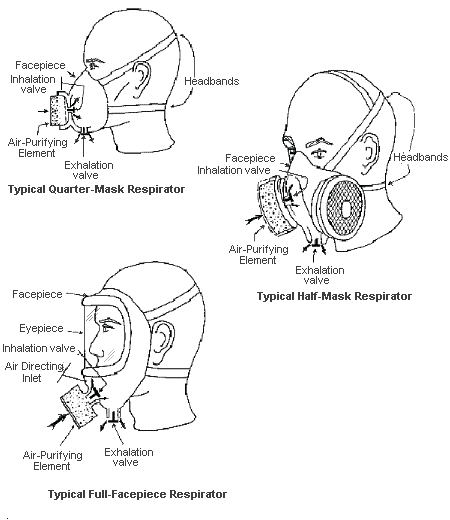
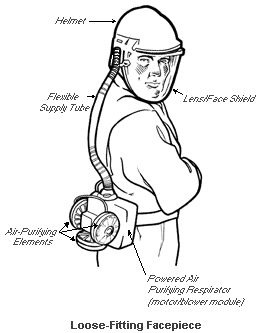

B. Airborne (or Respiratory) Hazards
May result from either an oxygen deficient atmosphere or breathing air contaminated with toxic particles, vapors, gases, fumes or mists. The proper selection and use of a respirator depend upon an initial determination of the concentration of the hazard or hazards present in the workplace, or the presence of an oxygen deficient atmosphere.
Airborne hazards generally fall into the following basic categories:
C. Respirator Classifications
Respirators provide protection either by removing contaminants from the air before they are inhaled or by supplying an independent source of respirable air. There are two major classifications of respirators:
Each class of respirator may have tight-fitting and loose-fitting facepieces. An important aspect of respirator operation and classification is the air pressure within the facepiece. When the air pressure within the facepiece is negative during inhalation with respect to the ambient air pressure, the respirator is termed a negative-pressure respirator. When the pressure is normally positive with respect to ambient air pressure throughout the breathing cycle, the respirator is termed a positive-pressure respirator. The concept of negative and positive pressure operation is important when considering potential contaminant leakage into the respirator.
D. Air Purifying Respirators
Are grouped into three general types: particulate removing, vapor and gas removing, and combination. Elements that remove particulates are called filters, while vapor and gas removing elements are called either chemical cartridges or canisters. Filters and canisters/cartridges are the functional portion of air-purifying respirators, and they can generally be removed and replaced once their effective life has expired. The exception would be filtering facepiece respirators (commonly referred to as "disposable respirators," "dust masks," or "single-use respirators"), which cannot be cleaned, disinfected, or resupplied with an unused filter after use.
E. Atmosphere-Supplying Respirators
Are respirators that provide air from a source independent of the surrounding atmosphere instead of removing contaminants from the atmosphere. These respirators are classified by the method that is used to supply air and the way in which the air supply is regulated. Basically, these methods are: self-contained breathing apparatus (air or oxygen is carried in a tank on the worker's back, similar to SCUBA gear); supplied-air respirators (compressed air from a stationary source is supplied through a high-pressure hose connected to the respirator); and combination self-contained and supplied-air respirators.
F. Limitations of Respirator Use
Not all workers can wear respirators. Individuals with impaired lung function, due to asthma or emphysema for example, may be physically unable to wear a respirator. Individuals who cannot get a good facepiece fit, including those individuals whose beards or sideburns interfere with the facepiece seal, will be unable to wear tight-fitting respirators. An adequate fit is required for a respirator to be effective. In addition to these problems, respirators may also be associated with communication problems, vision problems, fatigue, and reduced work efficiency.
In principle, respirators usually are capable of providing adequate protection. However, problems associated with selection, fit, and use often render them less effective in actual application; these problems prevent the assurance of consistent and reliable protection, regardless of the theoretical capabilities of the respirator. Occupational safety and health experts have spent considerable effort over the years developing fit-testing procedures and methods of measuring respirator effectiveness, thereby improving protection for those employees required to wear them.
A. The Standard
Whenever respirators are required to be worn, a written respirator protection program must be developed and implemented in accordance with OSHA's respirator standard, 29 CFR 1910.134. (Additional program requirements may be found in the standards that regulate the hazards to which the employee is exposed.) Because workplaces differ substantially, each program must be tailored to the specific conditions of the workplace. The program must consist of worksite-specific procedures governing the selection, use, and care of respirators. The program must be updated as often as necessary to reflect changes in workplace conditions and respirator use.
B. The Worksite-Specific Procedures
Must contain all the information needed to maintain an effective respirator program to meet the user's individual requirements. These procedures are a set of step-by-step instructions written so that a task (i.e., respirator use, fit-testing procedures, cleaning and storage, etc.) can be performed by all personnel in a uniform and consistent way, while supplying the maximum protection for workers who use respirators in the workplace. The employer must anticipate both the routine and non-routine use of respirators, as well as any possible emergency use based on the conditions in the workplace in which they are to be used. Worksite-specific procedures must be written so as to be useful to those who are directly involved in the respirator program: the program administrator, those fitting the respirators and training the workers, respirator maintenance workers, and the supervisors responsible for overseeing respirator use on the job.
C. Administration
In addition, the respirator standard requires that the respiratory protection program be administered by one qualified individual to ensure that the integrity of the respiratory protection program is maintained through the continuous oversight of one responsible person. The program administrator must be qualified by appropriate training and/or experience in the proper selection, use, and maintenance of respirators, be responsible for implementing the respiratory protection program, and conduct regular evaluations of the program's effectiveness.
Although responsibility for respirator program oversight rests with the program administrator, he or she may delegate responsibilities to other qualified individuals. For instance, a large facility may find it practical and economical to have a staff of personnel involved in the respirator program, each with their own area of responsibility. However, each of these people must report to the one administrator who has overall responsibility for the program. This approach promotes coordination of all facets of the program. The administrator should have the full support of higher level management; without it, an effective respirator program is difficult to initiate and maintain.
D. Elements
The respiratory protection program must cover the following basic elements, as applicable:
Respirator selection requires correctly matching the respirator with the hazard, the degree of hazard, and the user. The respirator selected must be adequate to effectively reduce the exposure of the respirator user under all conditions of use, including reasonably foreseeable emergency situations. Proper respirator selection involves choosing a device that fully protects the worker from the respiratory hazards to which he or she may be exposed and permits the worker to perform the job with the least amount of physical burden.
A. Selection Factors
Many factors must be considered carefully in respirator selection. In choosing the appropriate respirator, one must consider the nature and extent of the hazard, work requirements and conditions, and the characteristics and limitations of the respirators available. The following categories of information must be taken into account:
B. Selection
Once the above factors have been taken into account, the employer must select a NIOSH-certified respirator. Where NIOSH has not specifically certified any respirator for use against the particular contaminant present in the workplace, the employer must select a NIOSH-certified respirator that has no limitation prohibiting its use for that contaminant. The respirator must be appropriate for the contaminant's physical form and chemical properties and the conditions under which it will be used. All respirators must be chosen and used according to the limitations of the NIOSH certification, which appears on the NIOSH certification label.
C. Assigned Protection Factors
Until such time as OSHA addresses the issue of assigned protection factors (APF's), employers may rely on APF's published by NIOSH and ANSI. Where there are conflicts between the NIOSH and ANSI APF's, the employer should apply the more protective APF.
D. Warning System
When an air-purifying respirator is selected for protection against gases and vapors, a system must be in effect that will reliably warn respirator wearers of contaminant breakthrough. These systems are: a respirator equipped with an end-of-service life indicator (ESLI) certified by NIOSH for the contaminant, or an established and enforced cartridge/canister change schedule that is based on objective information or data that will ensure that canisters and cartridges are changed before the end of their service life.
E. Atmospheres Requiring Highest Level of Protection
For atmospheres that are immediately dangerous to life and health (IDLH), the highest level of respiratory protection and reliability is required. These atmospheres, by definition, are the most dangerous environments in which respirators are used. In these atmospheres, there is no tolerance for respirator failure. Consequently, only the following respirators must be provided and used: full-facepiece pressure demand self-contained breathing apparatus (SCBA) certified for a minimum service life of thirty minutes, or a combination full-facepiece pressure demand supplied-air respirator (SAR) with an auxiliary self-contained air supply.
A. Overview
Persons assigned to tasks that require the use of a respirator must be physically able to perform the work while using the respirator. Accordingly, employers have the responsibility of ensuring that employees are medically fit to tolerate the physical and psychological stress imposed by respirator use, as well as the physical stress originating from job and workplace conditions.
Employees must be medically evaluated and found eligible to wear the respirator selected for their use prior to fit testing or first-time use of the respirator in the workplace. Medical eligibility is to be determined by a physician or other licensed health care professional (referred to as a "PLHCP"). A variety of qualified health care providers, besides physicians, including occupational health nurses, nurse practitioners, and physician assistants, can perform the medical evaluations provided they are licensed to do so in the state in which they practice.
B. Questionnaire
In assessing the employee's medical eligibility to use a respirator, the PLHCP must perform a medical evaluation using a medical questionnaire (Appendix C to 1910.134) or provide a medical examination that obtains the same information as the medical questionnaire. The medical evaluation must be administered confidentially and at a time and place, during working hours, that is convenient to the employee. Employers are free to provide respirator users with a medical examination in lieu of the medical questionnaire if they chose to do so, but they are not required by the standard to administer a medical examination unless the employee gives a positive response to specific questions on the questionnaire.
C. Medical Factors and Conditions
The purpose of a medical evaluation program is to determine if employees can tolerate the physiological burden associated with respirator use, including: the burden imposed by the respirator itself (e.g., its weight and breathing resistance during both normal operation and under conditions of filter, canister, or cartridge overload); musculoskeletal stress (e.g., when the respirator to be worn is a SCBA); limitations on auditory, visual, and olfactory sensations; and isolation from the workplace environment. Since certain jobs and workplace conditions in which a respirator is used can also impose a physiological burden on the user, the medical evaluation must also consider the following factors: type and weight of the respirator to be worn; duration and frequency of respirator use; expected physical work effort; use of protective clothing and equipment to be worn; and temperature and humidity extremes that may be encountered. This information must be provided to the PLHCP before the PLHCP makes a recommendation regarding an employee's ability to use a respirator.
The medical evaluation is designed to identify general medical conditions that place employees who use respirators at risk of serious medical consequences. Medical conditions known to compromise an employee's ability to tolerate respirator-, job-, and workplace-related physiological stress include: cardiovascular and respiratory diseases (e.g., a history of high blood pressure, angina, heart attack, cardiac arrhythmias, stroke, asthma, chronic bronchitis, emphysema); reduced pulmonary function caused by other factors (e.g., smoking or prior exposure to respiratory hazards); neurological or musculoskeletal disorders (e.g., ringing in the ears, epilepsy, lower back pain); impaired sensory function (e.g., perforated ear drums, reduced or absent ability to smell); and psychological disorders (e.g., claustrophobia and severe anxiety).
D. Standard of Evaluation
The employer must obtain a written recommendation from the PLHCP on whether the employee is medically able to wear a respirator. The recommendation must identify any limitations on the employee's use of the respirator, as well as the need for follow-up medical evaluations that are needed to assist the PLHCP in making a recommendation. The employee must also receive a copy of the PLHCP's written recommendations. A powered air-purifying respirator (PAPR) must be provided to an employee if information from the medical evaluation indicates that the employee can use a PAPR but not a negative pressure respirator. If, subsequent to this evaluation, the PLHCP determines that the employee is able to wear a negative pressure respirator, the employer is no longer required to provide a PAPR to that employee.
In addition, the standard requires the employer to medically re-evaluate an employee when:
It has long been recognized that respirators must fit properly to provide protection. To obtain adequate respiratory protection, there must be a proper match between respirator and wearer. Respirators that don't seal properly around the face offer only the illusion of protection. To accommodate the variability of face size characteristics among individuals, a number of manufacturers offer facepieces in several sizes and models.
A. Purpose
The primary purpose of fit testing is to identify the specific make, model, style, and size of respirator best suited for each employee. In addition, fit testing also provides an opportunity to check on problems with respirator wear, and reinforces respirator training by having wearers review the proper methods of donning and wearing the respirator.
B. Requirement
Fit testing is required for all negative or positive pressure tight-fitting facepiece respirators. The OSHA respiratory protection standard requires that fit testing be performed before an employee first starts wearing a respirator in the work environment, whenever a different respirator facepiece is used, and at least annually thereafter.
C. Method
Prior to the actual fit test, the employee must be shown how to put on a respirator, position it on the face, set strap tension, and determine an acceptable fit. Next, the employee must be allowed to choose a respirator from a sufficient number of models and sizes so that the employee can find an acceptable and correctly fitting respirator. Once an acceptable respirator has been found -- which takes into account the position of the mask on the face, nose, and cheeks; room for eye protection; and room to talk -- a user seal check must be conducted (refer to on "Use of Respirators").
D. Types of Fit Testing
Fit testing may either be qualitative (QLFT) or quantitative (QNFT), and must be administered using an OSHA-accepted QLFT or QNFT protocol. These protocols are described in mandatory Appendix A to 1910.134. Prior to the commencement of the fit test, the employee must be given a description of the fit test and a description of the exercises that he or she will be performing during fit testing. The respirator to be tested must be worn for at least five minutes before the start of the fit test. The employee must be fit tested with the same make, model, style, and size of respirator that will be used in the workplace.
E. Fit Test Exercises
The following test exercises must be performed for all fit testing methods described in the OSHA standards, except the CNP method which has its own fit testing exercise regimen:
Each test exercise must be performed for one minute, except for the grimace exercise which must be performed for 15 seconds. The respirator must not be adjusted once the fit test exercises begin. Any adjustment voids the test, and the fit test must be repeated.
The employee must perform exercises in the test environment while wearing any applicable safety equipment that may be worn during actual respirator use and that could interfere with respirator fit. If the employee exhibits breathing difficulty during the fit test, he or she must be referred to a physician or other licensed health care professional to determine whether the employee can wear a respirator while performing his or her duties.
F. Retesting
If the employee finds the fit of the respirator unacceptable, he or she must be given a reasonable opportunity to select a different respirator and to be retested. In addition, retesting is required whenever an employee reports, or the employer, PLHCP, supervisor, or program administrator observe changes in an employee's physical condition that could affect respirator fit. Such conditions include, but are not limited to, facial scarring, dental changes (e.g., wearing new dentures), cosmetic surgery, or an obvious change in body weight.
A. Conditions
Once the respirator has been properly selected and fitted, it is necessary to ensure that the respirator is used properly in the workplace. The following conditions may compromise the effective use of the respirator and jeopardize worker protection: facepiece seal leakage; removing the respirator at the wrong times in hazardous atmospheres; not properly performing user seal checks; or not properly repairing defective parts. In these circumstances, there is the danger that employees may have a false sense of security in feeling that they are protected when they are not.
The employer must also be aware of the conditions in the work areas where employees are using respirators. Employers are required to routinely evaluate workplace conditions, the degree of employee exposure, and physical stress so that they can provide additional or different respiratory protection when necessary. By observing respirator use under actual workplace conditions, employers can note problems such as changes in the fit of a respirator due to the use of other protective equipment, or conditions leading to skin irritation.
B. Facepiece Seal Protection
User Seal Check. A user seal check (formerly known as a fit check) must be performed every time a tight-fitting respirator is put on or adjusted to ensure proper seating of the respirator to the face. The user seal check conducted must be either the positive and/or negative pressure checks described in Appendix VIII:2-2 of this chapter, or the manufacturer's recommended procedures (when equally protective). If the employee fails the user seal check test, another facepiece must be selected.
The employee must not have any hair growth (e.g., beard stubble, sideburns, or beard) that comes between the sealing surface of the respirator facepiece and the face, as well as hair that interferes with valve function, or any other condition that might interfere with the face-to-facepiece seal such as jewelry or facial makeup. The user seal check must be used for all respirators on which such checks are possible. If a user seal check cannot be performed on a tight-fitting respirator, the OSHA standard prohibits that respirator from being used.
C. Continuing Respirator Effectiveness
D. Immediately Dangerous to Life or Health (IDLH) Atmospheres
Atmospheres are IDLH when they pose an immediate threat to life, would cause irreversible adverse health effects, or would interfere with an individual's ability to escape from a dangerous atmosphere. Care must be exercised in these situations since failure of the respirator to provide the appropriate protection may result in serious injury or death. Consequently, the employer must develop and implement specific procedures for the use of respirators in IDLH atmospheres that include the following provisions:
E. Interior Structural Firefighting
In the ultra-hazardous situation of interior structural firefighting, firefighters must operate using a buddy system. Safeguards that may be adequate for well-controlled and well-characterized IDLH situations are not adequate in the uncontrolled and unpredictable situation characterized by a burning building. Therefore, in addition to the above safeguards for IDLH atmospheres, the following requirements apply to interior structural fire fighting:
The "two-in/two-out" requirement does not take effect until firefighters begin to perform interior structural fire fighting. While the fire is in the incipient stage (as determined by the commander or other person in charge), or when emergency rescue operations are required before the entire team has assembled, the standard does not require two-member teams inside and outside the structure.
A. Requirements
The OSHA standard requires that employers provide each respirator user with a respirator that is clean, sanitary, and in good working order. These requirements are a vital part of any successful respiratory protection program. To ensure that the respirator remains serviceable and delivers effective protection, a maintenance program must be in place prior to respirator use.
The OSHA respirator standard strongly emphasizes the importance of a good maintenance program, but permits its tailoring to the type of facilities, working conditions, and hazards involved. However, all programs are required to include at least:
In addition to the OSHA requirements, the manufacturer's instructions for inspection, cleaning, and maintenance of respirators should be consulted to ensure that the respirator continues to function properly. A proper maintenance program ensures that the worker's respirator remains as effective as when it was new.
B. Cleaning and Disinfecting
C. Storage
D. Inspection
To ensure the continued reliability of respiratory equipment, it must be inspected on a regular basis. The frequency of inspection and the procedures to be followed depend on whether the respirator is intended for non-emergency, emergency, or escape use only.
E. Repair
Respirators that fail to pass inspection or are otherwise found to be defective, must be removed from service, and discarded, repaired, or adjusted. Repairs or adjustments to respirators must be done only by appropriately trained personnel, using only the respirator manufacturer's NIOSH-approved parts designed for that respirator. The repairs also must be made in accordance with the manufacturer's recommendations and specifications regarding the type and extent of repairs to be performed. Because components such as reducing and admission valves, regulators, and alarms are complex and essential to the safe functioning of the respirator, they are required to be adjusted and repaired only by the manufacturer or a technician trained by the manufacturer.
A. Standards and Specifications
B. Other Specific Requirements
A. Identification of Filters, Cartridges, and Canisters
The employer must ensure that all filters, cartridges, and canisters used in the workplace are labeled and color coded with the NIOSH approval label, and ensure that the label is not removed and remains legible.
B. Training and Information
C. Program Evaluation
D. Recordkeeping
The OSHA respiratory protection standard requires the employer to establish and retain written information regarding medical evaluations, fit testing, and the respirator program. This information will promote employee involvement in the respirator program, assist the employer in auditing the adequacy of the program, and provide a record for compliance determinations by OSHA.
E. NIOSH Guidelines for the Selection and Use of Particulate Respirators
In June 1995, NIOSH updated and modernized the Federal Regulation for certifying air-purifying particulate respirators [42 CFR part 84]. As a consequence of this new regulation, NIOSH developed a User's Guide to familiarize respirator users with the new Part 84 certification regulations for particulate respirators, and to provide guidance for the selection and use of the new particulate respirators. The new regulation became effective on July 10, 1995, and replaces 30 CFR part 11 under which NIOSH and the Mine Safety and Health Administration (MSHA) jointly certified respirators before that date. The respirators certified under this new regulation are tested under much more demanding conditions than under the old regulation to provide increased worker protection. See Appendix VIII:2-4 of this chapter for a summary of the NIOSH Guide to the Selection and Use of Particulate Respirators Certified Under 42 CFR 84.
Air-purifying respirator a respirator with an air-purifying filter, cartridge, or canister that removes specific air contaminants by passing ambient air through the air-purifying element.
Assigned protection factor (APF) [reserved]
Atmosphere-supplying respirator a respirator that supplies the respirator user with breathing air from a source independent of the ambient atmosphere, and includes supplied-air respirators (SAR's) and self-contained breathing apparatus (SCBA) units.
Canister or cartridge a container with a filter, sorbent, or catalyst, or a combination of these items, that removes specific contaminants from the air passed through the container.
Demand respirator an atmosphere-supplying respirator that admits breathing air to the facepiece only when a negative pressure is created inside the facepiece by inhalation.
Emergency situation any occurrence such as, but not limited to, equipment failure, rupture of containers, or failure of control equipment that may or does result in an uncontrolled substantial release of an airborne contaminant.
Employee exposure an exposure to a concentration of an airborne contaminant that would occur if the employee were not using respiratory protection.
End-of-service-life indicator (ESLI) a system that warns the respirator user of the approach of the end of adequate respiratory protection; for example, that the sorbent is approaching saturation or is no longer effective.
Escape-only respirator a respirator intended to be used only for emergency exit.
Filtering facepiece (dust mask) a negative pressure particulate respirator with a filter as an integral part of the facepiece or with the entire facepiece composed of the filtering medium.
Filter or air purifying element a component used in respirators to remove solid or liquid aerosols from the inspired air.
Fit factor a quantitative estimate of the fit of a particular respirator to a specific individual, and typically estimates the ratio of the concentration of a substance in ambient air to its concentration inside the respirator when worn.
Fit test the use of a protocol to qualitatively or quantitatively evaluate the fit of a respirator on an individual. See also "Qualitative fit test (QLFT)" and "Quantitative fit test (QNFT)."
Helmet a rigid respiratory inlet covering that also provides head protection against impact and penetration.
High efficiency particulate air (HEPA) filter a filter that is at least 99.97% efficient in removing monodisperse particles of 0.3 micrometers in diameter and larger. The equivalent NIOSH 42 CFR part 84 particulate filters are the N100, R100, and P100 filters.
Hood a respiratory inlet covering that completely covers the head and neck, and may also cover portions of the shoulders and torso.
Immediately dangerous to life or health (IDLH) an atmosphere that poses an immediate threat to life, would cause irreversible adverse health effects, or would impair an individual's ability to escape from a dangerous atmosphere.
Interior structural firefighting the physical activity of fire suppression, rescue or both, inside of buildings or enclosed structures that are involved in a fire situation beyond the incipient stage.
Loose-fitting facepiece a respiratory inlet covering that is designed to form a partial seal with the face.
Maximum use concentration (MUC) [reserved]
Negative pressure respirator (tight fitting) a respirator in which the air pressure inside the facepiece is negative during inhalation with respect to the ambient air pressure outside the respirator.
Oxygen deficient atmosphere an atmosphere with an oxygen content below 19.5% by volume.
Physician or other licensed health care professional (PLHCP) an individual whose legally permitted scope of practice (i.e., license, registration, or certification) allows him or her to independently provide, or be delegated the responsibility to provide, some or all of the health care services required by 29 CFR 1910.134(e), "Medical evaluation."
Positive-pressure a respirator in which the pressure inside the respiratory inlet covering exceeds the ambient air pressure outside the respirator.
Powered air-purifying respirator (PAPR) an air-purifying respirator that uses a blower to force the ambient air through air-purifying elements to the inlet covering.
Pressure demand respirator a positive pressure atmosphere-supplying respirator that admits breathing air to the facepiece when the positive pressure is reduced inside the facepiece by inhalation.
Qualitative fit test (QLFT) a pass/fail fit test to assess the adequacy of respiratory fit that relies on the individual's response to the test agent.
Quantitative fit test (QNFT) an assessment of the adequacy of respirator fit by numerically measuring the amount of leakage into the respirator.
Respiratory inlet covering the portion of a respirator that forms the protective barrier between the user's respiratory tract and an air-purifying device or breathing air source, or both. It may be a facepiece, helmet, hood, suit, or a mouthpiece respirator with nose clamp.
Self-contained breathing apparatus (SCBA) an atmosphere-supplying respirator for which the breathing air source is designed to be carried by the user.
Service life the period of time that a respirator, filter or sorbent, or other respiratory equipment provides adequate protection to the wearer.
Supplied-air respirator (SAR) or airline respirator an atmosphere-supplying respirator for which the source of breathing air is not designed to be carried by the user.
Tight-fitting facepiece a respiratory inlet covering that forms a complete seal with the face.
User seal check an action conducted by the respirator user to determine if the respirator is properly seated to the face.
A. Facepiece Positive and/or Negative Pressure Checks
Positive Pressure Check
Close off the exhalation valve and exhale gently into the facepiece. The face fit is considered satisfactory if a slight positive pressure can be built up inside the facepiece without any evidence of outward leakage of air at the seal. For most respirators, this method of leak testing requires the wearer to first remove the exhalation valve cover before closing off the exhalation valve, and then carefully replacing it after the test.
Negative Pressure Check
Close off the inlet opening of the canister or cartridge(s) by covering it with the palm of the hand(s) or by replacing the filter seal(s). Inhale gently so that the facepiece collapses slightly, and hold your breath for ten seconds. The design of the inlet opening of some cartridges cannot be effectively covered with the palm of the hand, which requires that the test be performed by covering the inlet opening of the cartridge with a thin latex or nitrile glove. If the facepiece remains in its slightly collapsed condition, and no inward leakage of air is detected, the tightness of the respirator is considered satisfactory.
B. Manufacturer's Recommended User Seal Check Procedures
The respirator manufacturer's recommended procedures for performing a user seal check may be used instead of the positive and/or negative pressure check procedures, provided that the employer demonstrates that the manufacturer's procedures are equally effective in detecting seal leakage compared to the positive pressure and negative pressure checks described above.
These procedures are provided for employer use when cleaning respirators. They are general in nature, and the employer, as an alternative, may use the cleaning recommendations provided by the manufacturer of the respirators used by their employees, provided such procedures are as effective as those listed here. Equivalent effectiveness simply means that the procedures used must accomplish the objectives set forth in this Appendix (i.e., must ensure that the respirator is properly cleaned and disinfected in a manner that prevents damage to the respirator and does not cause harm to the user).
A.
Remove filters, cartridges, or canisters. Disassemble facepieces by removing speaking diaphragms, demand or pressure-demand valve assemblies, hoses, or any components recommended by the manufacturer. Discard or repair any defective parts.
B.
Wash components in warm (43°C/110°F maximum) water with a mild detergent or with a cleaner recommended by the manufacturer. A stiff bristle (not wire) brush may be used to facilitate the removal of dirt.
C.
Rinse components thoroughly in clean, warm (43°C/110°F maximum), preferably running, water. Drain the components.
D.
When the cleaner used does not contain a disinfecting agent, respirator components should be immersed for two minutes in:
E.
Rinse components thoroughly in clean, warm (43°C/110°F maximum), preferably running, water. Drain the components. The importance of thorough rinsing cannot be overemphasized. Detergents or disinfectants that dry on facepieces may result in dermatitis. In addition, some disinfectants may cause deterioration of rubber or corrosion of metal parts if not completely removed.
F.
Components should be hand-dried with a clean, lint-free cloth, or air-dried.
G.
Reassemble facepiece, replacing filters, cartridges, and canisters where necessary.
H.
Test the respirator to ensure that all components work properly.
Summary for Respirator Users
This summary presents a brief overview of what the respirator user needs to know about the new categories of particulate respirators certified by the National Institute for Occupational Safety and Health (NIOSH).
NIOSH has developed a new set of regulations in 42 CFR 84 (also referred to as "Part 84") for testing and certifying nonpowered, air-purifying, particulate-filter respirators. The new Part 84 respirators have passed a more demanding certification test than the old respirators (e.g., dust and mist [DM], dust, fume and mist [DFM], spray paint, pesticide, etc.) certified under 30 CFR 11 (also referred to as "Part 11").
Changes in the new regulations involve only nonpowered, air-purifying, particulate-filter respirators. Certification requirements for all other classes of respirators (e.g., chemical cartridges, self-contained breathing apparatus [SCBA], airlines, gas masks without a particulate filter, powered air-purifying respirators [PAPR's] equipped with high-particulate air [HEPA] filters, etc.) have been transferred to Part 84 without change. Until further notice, the Occupational Safety and Health Administration (OSHA) is allowing the continued use of Part 11 particulate-filter respirators. Under Part 84, NIOSH is allowing manufacturers to continue selling and shipping Part 11 particulate filters as NIOSH-certified until July 10, 1998.
The new Part 84 regulation provides for nine classes of filters (three levels of filter efficiency, each with three categories of resistance to filter efficiency degradation). The three levels of filter efficiency are 95%, 99%, and 99.97%. The three categories of resistance to filter efficiency degradation are labeled N, R, and P. The class of filter will be clearly marked on the filter, filter package, or respirator box. For example, a filter marked N95 would mean an N-series filter that is at least 95% efficient. Chemical cartridges that include particulate filter elements will carry a similar marking that pertains only to the particulate filter element.
Filter efficiency is the stated percentage of particles removed from the air. Filter efficiency degradation is defined as a lowering of filter efficiency or a reduction in the ability of the filter to remove particles as a result of workplace exposure.
The new classes of nonpowered particulate respirators require new decision logic for selection of the proper respirator. The selection process for using the new particulate classification is outlined as follows and is discussed in Section II of NIOSH Guide to the Selection and Use of Particulate Respirators Certified Under 42 CFR 84:
If oil particles (e.g., lubricants, cutting fluids, glycerine, etc.) are present, use an R-or P-series filter.
NOTE: N-series filters cannot be used if oil particles are present.
If oil particles are present and the filter is to be used for more than work shift, use only a P-series filter.
NOTE: To help you remember the filter series, use the following guide:
N for Not resistant to oil
R for Resistant to oil
P for oil-Proof
Call 1-800-35-NIOSH (1-800-356-4674) for additional information or for free single copies of the complete document NIOSH Guide to the Selection and Use of Particulate Respirators Certified Under 42 CFR 84 [DHHS (NIOSH) Publication No. 96-101].
Ways to save money AND help the environment:
Save water AND money with this showerhead adapter, it lets the water flow until the water is hot, then shuts off water flow until you restart it, ShowerStart TSV Hot Water Standby Adapter

Protect your health with these:
Mattress Dust mite-Bedbug protector, 100% Waterproof, Hypoallergenic, Zippered
Handheld Allergen Vacuum Cleaner with UV Sanitizing for Allergies and Pet, Kills Mite, Virus, Molds, True HEPA with Powerful Suction removes Hair, Dander, Pollen, Dust ,
,
Immune Support Supplement with Quercetin, Vitamin C, Zinc, Vitamin D3
GermGuardian Air Purifier with UV-C Light and HEPA 13 Filter, R emoves 99.97% of Pollutants
HEPA Air Purifier, HEPA Air Cleaner with Washable Pre-Filter, AQI Display, ECO Mode, Sleep Mode, Pet Mode for Pets, Dust, Pollen, Removes 99.97% of Particles, Smoke, Mold, Pet Dander, Dust, Odors
Interesting Reads:
THE PREPPER'S CANNING & PRESERVING BIBLE: [13 in 1] Your Path to Food Self-Sufficiency. Canning, Dehydrating, Fermenting, Pickling & More, Plus The Food Preservation Calendar for a Sustainable Pantry
The Backyard Homestead: Produce all the food you need on just a quarter acre! P aperback
The Citizens' Guide to Geologic Hazards: A Guide to Understanding Geologic Hazards Including Asbestos, Radon, Swelling Soils, Earthquakes, Volcanoes
The Uninhabitable Earth: Life After Warming
Book: The Sixth Extinction:
An Unnatural History Paperback
 .
.