

Fleas Infesting our Pets and Homes
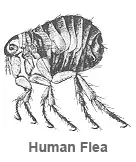
Fleas are small, wingless insects, flattened from side to side, that infest the hair coats of mammals or plumage of birds. Adult fleas have piercing mouthparts which they insert into the skin of their host to feed on blood. Worldwide there are more than 2,400 species of fleas. Luckily, only a few flea species feed on humans and on our dogs and cats with any regularity.
There are 5 types of fleas, the first 3 are common around pets and humans, thankfully the rat fleas are rarely found on humans in North America:
Cat and dog fleas infested humans when pets sleep or rest on the same bed. Cat and dog fleas also will infest certain types of wild carnivores, including opossums and raccoons, but not squirrels, rats or mice. While these two species do not carry human diseases, they can carry tapeworms (Dipylidium caninum) that infect dogs (but not humans).
This publication is primarily concerned with the cat flea, Ctenocephalides felis, which is by far the most common flea species found on both dogs and cats and in our homes. Control methods discussed in this publication are generally effective against any other flea species that may be occasionally found on our pets or in our homes.
Adult male cat fleas are only about 1 /12 to 1 /8 inch long (2 to 3 millimeters); blood-engorged females range up to 1 /5 inch long (4 to 5 millimeters). Newly emerged fleas are very dark brown. Thereafter, their colors are somewhat lighter. Actively reproducing females are light brown to orange.
Fleas often probe the skin before taking a blood meal. After 30 minutes, lines or clusters of itchy red marks appear. On sensitive persons, bites develop into raised bumps within 24 hours after being bitten.
Cat fleas can carry the double pore dog tapeworm, Dipylidium caninum. This tapeworm is normally a parasite of dogs and cats, but it can infect children who ingest a cat flea that contains an immature stage of the tapeworm . The immature stage of the tapeworm emerges from the ingested flea and begins to develop in the intestine of the child. This tapeworm does not cause obvious symptoms and is not a cause of serious disease, but you should consult with a physician if an infection is suspected. The most obvious sign of infection in a child is the appearance of a stage of the tapeworm, known as a "proglottid," in a child's bowel movement. A proglottid is whitish, about the size and shape of a pumpkin seed, and capable of undulating movements.
Going to a tropical beach? Then read this: the chigoe flea, also called a "sand flea" (Tunga penetrans) larvae are usually found in sandy soil usually associated with pigs and pig feces. However, chigoe fleas also are found in the sand of coastal beaches. Female T. penetrans infect people by penetrating into tender flesh between toes or into the soles of the feet. There, the 1-mm long females become embedded, begin to suck blood, and eventually develop eggs. As they do, their body swells about 80-fold, reaching the size of a pea and causing intense pain. Sites of infestation may become infected with bacteria and, if untreated, may eventually require amputation. The best prevention for vacationers is to avoid going barefoot in regions where this flea is common, including on beaches associated with the Caribbean Sea.
Fleas develop by complete metamorphosis. Like the butterfly, the life cycle of the flea involves an egg, larva, pupa (cocoon), and adult. The reproductive cycle of the female flea begins 24 to 36 hours after her first blood meal, when she lays her first egg. A female cat flea can lay as many as 40 eggs per day and over 2,000 eggs in her lifetime. Egg numbers vary because the reproductive capacity of the flea is dependent upon environmental and host-related factors, such as the extent of grooming activity by the host, temperature and humidity.
Flea eggs are pearly white, oval and the size of a grain of sand 1 /50 inch ( 0.5 millimeters ). The eggs are not sticky and easily roll off the fur of the host when laid. Flea eggs usually hatch in 1 to 10 days, depending on the temperature and humidity (humidity of 50 percent or less will desiccate eggs and larvae). Newly hatched flea larvae are slender, yellow, segmented, maggot-like and 1 /25 to 1 /12 inch long (1 to 2 millimeters). Larvae are free living and feed on organic debris found in their environment. They also feed on adult flea feces, which is partially digested dried blood. Once the larvae have ingested adult flea feces they become darker in color. Larvae do not like direct light. They move actively, deep among carpet fibers or under organic debris (grass, branches, leaves, or soil), searching for food. The larval stage usually lasts for 5 to 11 days, depending upon the availability of food and the climatic conditions. Temperatures below 65� to 70�F prolong larval development. After completing development, the mature larva, which is 1 /6 to 1 /5 inch in length (4 to 5 millimeters), moves to an undisturbed site to produce a silk-like
Newly emerged fleas are attracted to house pets by the warmth of the animals body, movement, changes in light intensity, and exhaled carbon dioxide. Fleas have tremendously powerful back legs, which they use for jumping onto their host. It has been reported that cat fleas can jump as high as 13 inches. When stimulated, the flea will jump toward the source of the stimulus and try to attach to a suitable host. It is these newly emerged fleas that are found in the carpet and most often bite humans before finding their preferred host (dog, cat, ferret, raccoon, opossum). The newly emerged fleas can survive for 1 to 3 weeks without feeding, but as soon as they are on a suitable host they will feed and mate, and females will begin egg production within 24 to 36 hours.
Fleas are unlikely to be in the center of a spacious room or sunny yard. This is because pets typically do not rest in these spots and they lack enough organic and fecal debris (from the feeding of adult fleas) to feed developing larvae. Also, fleas require relatively high humidity for development. A sunny spot in the middle of a lawn would usually be too hot in summer and have insufficient moisture and humidity to support fleas.
Vacuum: Vacuuming picks up all stages of fleas, directly reducing
the population as well as removing dirt and loosening up the carpet fibers
that can prevent the flea pesticide applications (one reason why total
release aerosol "bombs" are not very effective against fleas). In addition,
physical pressure on the carpet from vacuuming can trigger the emergence of
fleas from their pupal cocoons, exposing them to pesticide applications.
After vacuuming and cleaning, pesticides labeled for flea control can be
applied as spot treatments. Products containing permethrin or pyrethrins may
kill adult fleas, but not flea eggs and pupae. Dust formulations, such as
those containing boric acid, silica or diatomaceous earth, will kill flea
adults and larvae. These materials can be applied as a very fine layer of
dust to areas likely to harbor fleas, such as rugs, carpeting, cracks in
flooring, beneath furniture cushions, in crawl spaces and under porches.
Thus spot applications of pesticides are most effective.
Flea and tick products range from pills given by mouth to collars, sprays, dips, shampoos, powders, and "spot-ons," liquid products squeezed onto the dog's or cat's skin usually between the shoulder blades or down the back. A few spot-on products are available for flea control in ferrets, and fly and tick control in horses.
The spot on treatments, like Frontlione, Advantage, etc. and the most effective, and are generallyu applied only onece a month. They became much inproved in 2012, after complaints from pet owners about adverse reactions from their p[ets caused the EPA to regulate them more tightly. Costco and Sam's Club usually carry equally effective generic forms of these at a much reduced price.
Ways to save money AND help the environment:
Save water AND money with this showerhead adapter, it lets the water flow until the water is hot, then shuts off water flow until you restart it, ShowerStart TSV Hot Water Standby Adapter

Protect your health with these:
Mattress Dust mite-Bedbug protector, 100% Waterproof, Hypoallergenic, Zippered
Handheld Allergen Vacuum Cleaner with UV Sanitizing for Allergies and Pet, Kills Mite, Virus, Molds, True HEPA with Powerful Suction removes Hair, Dander, Pollen, Dust ,
,
Immune Support Supplement with Quercetin, Vitamin C, Zinc, Vitamin D3
GermGuardian Air Purifier with UV-C Light and HEPA 13 Filter, R emoves 99.97% of Pollutants
HEPA Air Purifier, HEPA Air Cleaner with Washable Pre-Filter, AQI Display, ECO Mode, Sleep Mode, Pet Mode for Pets, Dust, Pollen, Removes 99.97% of Particles, Smoke, Mold, Pet Dander, Dust, Odors
Interesting Reads:
THE PREPPER'S CANNING & PRESERVING BIBLE: [13 in 1] Your Path to Food Self-Sufficiency. Canning, Dehydrating, Fermenting, Pickling & More, Plus The Food Preservation Calendar for a Sustainable Pantry
The Backyard Homestead: Produce all the food you need on just a quarter acre! P aperback
The Citizens' Guide to Geologic Hazards: A Guide to Understanding Geologic Hazards Including Asbestos, Radon, Swelling Soils, Earthquakes, Volcanoes
The Uninhabitable Earth: Life After Warming
Book: The Sixth Extinction:
An Unnatural History Paperback
 .
.