
A recent study reported by Fox News on July 20, 2010, shows a connection between the use of certain household products and cancer. According to in Massachusetts, the frequent use of slow release air fresheners and anti-mold products can double a woman's risk of developing breast cancer.
The study was published in the international journal Environmental
Health on July 18, 2010, according to Fox News. But we cannot
find any other references in Google to either this study, nor the
magazine.
According to Fox's article, cleaners, air fresheners
and mold removers doubled the risk of breast cancer in women who used
them most often, while mothballs, pesticides and insect repellents
had less of an impact on the risks of women developing breast cancer.
The theory proposed is the possible presence of endocrine disrupting
chemicals and other carcinogens in the products.
The study was merely a survey of women who had breast cancer, asking them to recall what products they use. Studies of this type are subject to "recall bias" as they depend on people remembering events from years before.
Most people spend at least half their lives inside their homes. The air inside can be more harmful to your family's health than the air outdoors. Common sense suggests that you ought to understand the nature and risks of the products you use at home and limit your exposure to them.
|
Children can spend 90% of their time indoors. For their size, children breathe up to twice as much air as adults. That means children are at greater risk for health problems that come from indoor air pollution. |
It is not always easy to tell if you have poor air quality. You may notice bad smells and see smoke, but you cannot see or smell other dangers, like carbon monoxide or radon. This page and those on asthma and allergies, mold and carbon monoxide will help you ask the right questions to find out if the air inside your home is safe and healthy. They will also give you ideas about how to fix any problems you might find.
There are also many products that can be dangerous to use in the home:
You can be exposed by
The potential for harm from exposure depends on the following factors:
- the type and concentration of dangerous chemical in the product
- how much of the chemical you are exposed to
- how often you are exposed
- your size, weight and health (smaller and younger increases the risk)
- your age
Common short term symptoms are
Long term symptoms, which may take months or years to develop, include
Asthma & Allergies
If someone in your home has health problems or is ill, polluted indoor air can make them feel worse. For example, asthma is a lung disease that affects a growing number of children. Indoor air pollution can make it worse. insects and other pests can also be a real problem for people with asthma or allergies. For example, cockroach and dust mite droppings cause asthma attacks in some people. Pesticides can help fight these pests but they can be dangerous. Click here for more information about using bug spray and other pesticides safely. Click here to find out about making your home healthier for people with asthma or allergies.
Mold
Mold grows in wet or damp places. It often smells musty. Many people are allergic to mold. Some kinds of mold are toxic, and coming in contact with large amounts of mold may cause health problems for you or your family. Click here to learn more about how to control in your home.
Carbon Monoxide
Carbon monoxide is a deadly gas that can come from appliances that burn gas, oil, coal, or wood, and are not working as they should. Car exhaust also has carbon monoxide. You cannot see, taste, or smell carbon monoxide. Click here for more information on how to protect your family from carbon monoxide poisoning.
Other Indoor Air Problems
Radon is another gas. It can come into homes from the ground below them. You cannot see, taste, or smell radon. Radon is found all over the United States. Radon can cause lung cancer. In fact, it is the second leading cause of lung cancer in the U.S. If you smoke and your home has high levels of radon, your risk of lung cancer is especially high.
|
Combustion appliances are one source of possible air pollution |
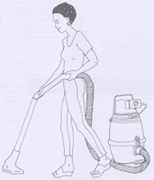
Sometimes indoor air pollution comes from what people do in their home.
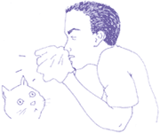 Sometimes
indoor air pollution comes from what people have in their homes.
Sometimes
indoor air pollution comes from what people have in their homes.
There are simple, but important steps you can take to find our what is causing poor air quality. The questions below can help you find problems around your home. This section will give you ideas of what to do. Look at the chapters on asthma and allergies, mold, carbon monoxide to learn more about indoor air problems. Remember, making your home a safer, healthier place to live may mean taking serveral steps.
Questions To Ask?
Your family's health
Radon
Living in a Healthy Home
Action steps
 Be
sure to check the Action Steps in the chapters on
asthma and allergies,
mold, and
carbon monoxide. You will find good suggestions for cutting down
on pollution in your home and making the air healthier.
Be
sure to check the Action Steps in the chapters on
asthma and allergies,
mold, and
carbon monoxide. You will find good suggestions for cutting down
on pollution in your home and making the air healthier.
Test your home for radon
You can buy low cost radon test kits at hardware or home supply stores. Or call your local health department for more information.
Living in a Healthy Home
When In Doubt, Check It Out
U.S. Environmental Protection Agency Indoor Air Quality Information Home Page -- http://www.epa.gov/iaq
Indoor Air Quality Information Clearhinghouse
(IAQ INFO)
(800) 438- 4318
Monday- Friday, 9: 00am- 5: 00pm
EST
or email: iaqinfo@aol.com
National Radon Information Hotline
(800) SOS
RADON; (800) 767-7236
National Lead Information Center
(800) LEAD INFO; (800) 532-3394
National Hispanic Indoor Air Quality Hotline
(800) SALUD-12; (800) 725-8312
Monday- Friday, 9: 00am- 6: 00pm
EST
American Lung Association, Contact your local
organization or call
(800) LUNG- USA; (800) 586-4872
visit the
web at http://www.lungusa.org
Healthy Indoor Air for America's Homes
(406) 994- 3451
http://www.healthyindoorair.org
Home* A* Syst: An Environmental Rist
Assessment Guide for the Home contains information about indoor air
quality and other healthy home topics.
(608) 262- 0024
http://www.uwex.edu/homeasyst
Ways to save money AND help the environment:
Save water AND money with this showerhead adapter, it lets the water flow until the water is hot, then shuts off water flow until you restart it, ShowerStart TSV Hot Water Standby Adapter

Protect your health with these:
Mattress Dust mite-Bedbug protector, 100% Waterproof, Hypoallergenic, Zippered
Handheld Allergen Vacuum Cleaner with UV Sanitizing for Allergies and Pet, Kills Mite, Virus, Molds, True HEPA with Powerful Suction removes Hair, Dander, Pollen, Dust ,
,
Immune Support Supplement with Quercetin, Vitamin C, Zinc, Vitamin D3
GermGuardian Air Purifier with UV-C Light and HEPA 13 Filter, R emoves 99.97% of Pollutants
HEPA Air Purifier, HEPA Air Cleaner with Washable Pre-Filter, AQI Display, ECO Mode, Sleep Mode, Pet Mode for Pets, Dust, Pollen, Removes 99.97% of Particles, Smoke, Mold, Pet Dander, Dust, Odors
Interesting Reads:
THE PREPPER'S CANNING & PRESERVING BIBLE: [13 in 1] Your Path to Food Self-Sufficiency. Canning, Dehydrating, Fermenting, Pickling & More, Plus The Food Preservation Calendar for a Sustainable Pantry
The Backyard Homestead: Produce all the food you need on just a quarter acre! P aperback
The Citizens' Guide to Geologic Hazards: A Guide to Understanding Geologic Hazards Including Asbestos, Radon, Swelling Soils, Earthquakes, Volcanoes
The Uninhabitable Earth: Life After Warming
Book: The Sixth Extinction:
An Unnatural History Paperback
 .
.