
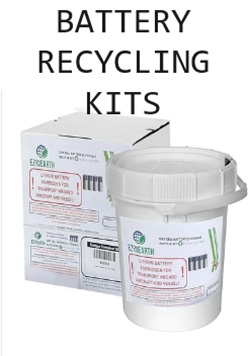
You might also like these convenient all-in-one battery recycling collection containers. There good for home or business. They're obvious and clear, no explanation required. It has everything you need, Everything you need to easily and safely recycle batteries: an attractive box, instructions, a roll of tape, required labels, and a D.O.T. Special Permit.
Click here to to find where you can drop off rechargeable batteries for recycling.
Are you looking for recycling centers and options for rechargeable batteries, such as NiCd (nicad, nickel-cadmium), lithium or other rechargeable batteries that no longer hold a charge? See this page for recycling locations for batteries from businesses, or this page for household batteries!One way to reduce the number of batteries in the waste stream is to purchase rechargeable batteries. Nearly one in five dry-cell batteries purchased in the United States is rechargeable. Over its useful life, each rechargeable battery may substitute for hundreds of single-use batteries.
 | |
 | |
Rechargeable battery usage tips provided by the rechargeable power industry. These are general tips in reference to proper battery handling, storage and charging. Always refer to the owner's manual for specific usage guidelines. RBRC is the authority in rechargeable battery RECYCLING and provide these tips as a public service. Frequently Asked Questions: |
| Q | What happens to the recycled batteries after I drop them off at a participating retail store? | |
| A | Retailers collect your spent battery packs and ship them to the recycling facility for processing. The reclaimed materials can be used in new products - such as new batteries and stainless steel products.
| |
| Q | Which rechargeable batteries can be recycled? | |
| A | The following rechargeable battery chemistries can be recycled - Nickel Cadmium (Ni-Cd), Nickel Metal Hydride (Ni-MH), Lithium Ion (Li-ion), and Small Sealed Lead* (Pb). Look for the Battery Recycling Seal on the battery. * weighing up to 2lbs/1kg per battery
| |
| Q | Where can I recycle my used rechargeable batteries? | |
| A | At any of the participating retailers. In the U.S.: Alltel, Batteries Plus, BellSouth Cellular, Black & Decker, Cingular Wireless, Circuit City, Home Depot, RadioShack, Remington, Sears and Orchard Supply, Target, Wal-Mart and Wireless Zone. And in Canada: Astral Photo Images, Authorized Motorola Dealers, Battery Plus, Bell Mobility, Black's Photography, Canadian Tire, Future Shop, Home Depot, Home Hardware, London Drugs, Makita Factory Service Centers, Personal Edge and Centre du Rasoir, RadioShack Canada, Revy, Telus and Zellers. Recycling used RECHARGEABLE household batteries is now possible! To find a center near you that will take them, click here! (or
if you are in Canada )( Which types do they take? Nickel Cadmium (Ni-Cd), Nickel Metal Hydride (Ni-MH), Lithium Ion (Li-ion), and Small Sealed Lead* (Pb) rechargeable batteries are commonly found in cordless power tools, cellular and cordless phones, laptop computers, digital cameras, two-way radios, camcorders and remote control toys. Use the RBRC collection site locator, or call the consumer helpline, 1-800-8-BATTERY, to find the retail collection site nearest you.
| |
| Q | Can I include my batteries with other recyclable materials in my local recycling program? | |
| A | RBRC offers a recycling plan for communities to incorporate rechargeable batteries into an already established household waste collection program. Check with your local community to see if they are a part of the RBRC recycling program.
| |
| Q | Can I still recycle my battery if it does not have the seal on it? | |
| A | Yes. As long as it's a Ni-Cd, Ni-MH, Li-ion or Pb* rechargeable battery. Most batteries will have the chemistry listed on the battery pack. * weighing less than 2lbs/1kg per battery
| |
| Q | Why should I recycle rechargeable batteries? | |
| A | By recycling your used rechargeable batteries, you are helping to create a cleaner and safer environment, keeping harmful rechargeable battery by-products out of landfills and the solid waste stream.
| |
| Q | Which products use rechargeable batteries? | |
| A | Nickel Cadmium (Ni-Cd), Nickel Metal Hydride (Ni-MH), Lithium Ion (Li-ion), and Small Sealed Lead* (Pb) rechargeable batteries are commonly found in cordless power tools, cellular and cordless phones, laptop computers and camcorders. * weighing less than 2lbs/1kg per battery
| |
| Q | Do you recycle car batteries? | |
| A | No. Although car batteries "recharge" themselves, they are not the type of batteries accepted in the RBRC program.
Ways to save money AND help the environment: Eat healthier AND save money: Instant Pot Duo 7-in-1 Electric 8 QT Pressure Cooker, Slow Cooker, Rice Cooker, Steamer, Sauté, Yogurt Maker, Warmer, Sterilizer, Pot is Stainless Steel 
Protect your health with these:
| |
 it lets the water flow until the water is hot, then shuts off water flow until you restart it, ShowerStart TSV Hot Water Standby Adapter
 ,
,
 emoves 99.97% of Pollutants

 aperback
  .
.