Translate this page to any language by choosing a language in the box below.
Major requirements and Overview of OSHA Respiratory Protection Requirements
Major requirements and Overview of OSHA Respiratory Protection Requirements
Major Requirements of OSHA's
Respiratory Protection Standard
29 CFR 1910.134
Back to the Table of Contents page for information on many other subjects!

Major Requirements of 29 CFR 1910.134 |
|
Introduction
- This standard, which replaces the respiratory protection standards adopted by OSHA in 1971 (29 CFR 1910.134 and 29 CFR 1926.103), applies to General Industry (Part 1910), Shipyards (Part 1915), Marine Terminals (Part 1917), Longshoring (Part 1918), and Construction (Part 1926).
- Respirator-related provisions of OSHA's existing standards are revised to conform to each other and to revised 29 CFR 1910.134.
- All provisions addressing respirator use, selection, and fit testing are deleted from OSHA's substance-specific standards.
- The entire previous respirator standard, 29 CFR 1910.134, is redesignated as 29 CFR 1910.139 Respirator protection for M. tuberculosis, and will continue to apply to respirator use for protection against exposure to TB until the TB standard is finalized (proposal 62 FR 54160, Oct. 17, 1997).
(a) Permissible Practice (p. 1179)
- Paragraphs (a)(1) and (a)(2) are essentially unchanged from the corresponding paragraphs of the prior standard. Paragraph (a)(1) establishes the hierarchy of controls by requiring the use of respirators when "effective engineering controls are not feasible, or while they are being instituted."
- Paragraph (a)(2) requires employers to provide employees with respirators that are "applicable and suitable" for the purpose intended "when such equipment is necessary to protect the health of the employee."
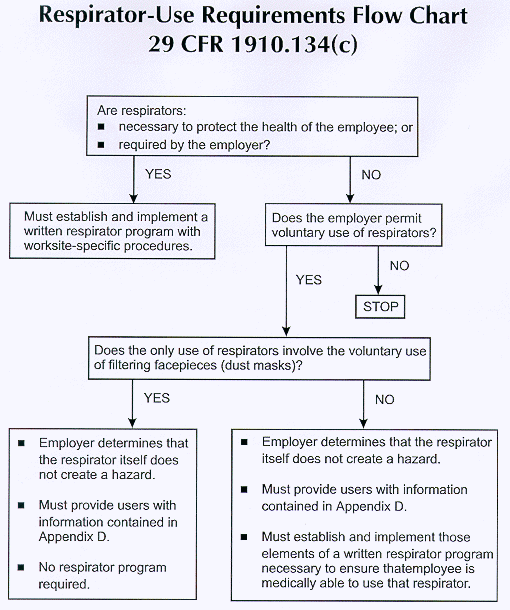
(b) Definitions (p. 1181) This paragraph contains definitions of important terms used in the regulatory text. The previous respiratory protection standard contained no definitions. (c) Respiratory Protection Program (p. 1187)
- Must designate a qualified program administrator to oversee the program.
- Must provide respirators, training, and medical evaluations at no cost to the employee.
- OSHA has prepared a Small Entity Compliance Guide that contains criteria for selection of a program administrator and a sample program.
(d) Selection of Respirators (p. 1195)
- Must select a respirator certified by the National Institute for Occupational Safety and Health (NIOSH) which must be used in compliance with the conditions of its certification.
- Must identify and evaluate the respiratory hazards in the workplace, including a reasonable estimate of employee exposures and identification of the contaminant's chemical state and physical form.
- Where exposure cannot be identified or reasonably estimated, the atmosphere shall be considered immediately dangerous to life or health (IDLH).
- Respirators for IDLH atmospheres:
- Approved respirators:
- full facepiece pressure demand self-contained breathing apparatus (SCBA) certified by NIOSH for a minimum service life of thirty minutes, or
- combination full facepiece pressure demand supplied-air respirator (SAR) with auxiliary self-contained air supply.
|
- All oxygen-deficient atmospheres (less than 19.5% O2 by volume) shall be considered IDLH.
Exception: If the employer can demonstrate that, under all foreseeable conditions, oxygen levels in the work area can be maintained within the ranges specified in Table II (i.e., between 19.5% and a lower value that corresponds to an altitude-adjusted oxygen partial pressure equivalent to 16% oxygen at sea level), then any atmosphere-supplying respirator may be used.
- Respirators for non-IDLH atmospheres:
- For protection against gases and vapors, the employer shall provide:
- an atmosphere-supplying respirator, or
- an air-purifying respirator, provided that:
- respirator is equipped with an end-of-service-life indicator (ESLI) certified by NIOSH for the contaminant; or
- if there is no ESLI appropriate for conditions of the employer's workplace, the employer implements a change schedule for canisters and cartridges that will ensure that they are changed before the end of their service life and describes in the respirator program the information and data relied upon and basis for the change schedule and reliance on the data.
- For protection against particulates, the employer shall provide:
- an atmosphere-supplying respirator; or
- an air-purifying respirator equipped with high efficiency particulate air (HEPA) filters certified by NIOSH under 30 CFR Part 11 or with filters certified for particulates under 42 CFR Part 84; or
- an air-purifying respirator equipped with any filter certified for particulates by NIOSH for contaminants consisting primarily of particles with mass median aerodynamic diameters of at least 2 micrometers.
(e) Medical Evaluation (p. 1207)
- Must provide a medical evaluation to determine employee's ability to use a respirator, before fit testing and use.
- Must identify a physician or other licensed health care professional (PLHCP) to perform medical evaluations using a medical questionnaire or an initial medical examination that obtains the same information as the medical questionnaire (information required is contained in mandatory Appendix C).
- Must obtain a written recommendation regarding the employee's ability to use the respirator from the PLHCP.
- Additional medical evaluations are required under certain circumstances, e.g.:
- employee reports medical signs or symptoms related to ability to use respirator;
- PLHCP, program administrator, or supervisor recommends reevaluation;
- information from the respirator program, including observations made during fit testing and program evaluation, indicates a need; or
- change occurs in workplace conditions that may substantially increase the physiological burden on an employee.
- Annual review of medical status is not required.
(f) Fit Testing (p. 1221)
- All employees using a negative or positive pressure tight-fitting facepiece respirator must pass an appropriate qualitative fit test (QLFT) or quantitative fit test (QNFT).
- Fit testing is required prior to initial use, whenever a different respirator facepiece is used, and at least annually thereafter. An additional fit test is required whenever the employee reports, or the employer or PLHCP makes visual observations of, changes in the employee's physical condition that could affect respirator fit (e.g., facial scarring, dental changes, cosmetic surgery, or an obvious change in body weight).
- The fit test shall be administered using an OSHA-accepted QLFT or QNFT protocol, as contained in mandatory Appendix A.
- QLFT Protocols:
- Isoamyl acetate
- Saccharin
- Bitrex
- Irritant smoke
- QNFT Protocols:
- Generated Aerosol (corn oil, salt, DEHP)
- Condensation Nuclei Counter (PortaCount)
- Controlled Negative Pressure (Dynatech FitTester 3000)
- QLFT may only be used to fit-test negative pressure air-purifying respirators (APRs) that must achieve a fit factor of 100 or less.
- If the fit factor determined through QNFT is 100 for tight-fitting half facepieces, or 500 for tight-fitting full facepieces, the QNFT has been passed with that respirator.
| Note: If a particular OSHA standard (e.g., 29 CFR 1910.1001 Asbestos) requires the use of a full facepiece APR capable of providing protection in concentrations up to 50 times the Permissible Exposure Limit (PEL), this respirator must be QNFT. This is because a protection factor of 50 (50 X PEL) multiplied by a standard safety factor of 10 is equivalent to a fit factor of 500. The safety factor of 10 is used because protection factors in the workplace tend to be much lower than the fit factors achieved during fit testing. The use of a safety factor is a standard practice supported by most experts to offset this limitation. This is discussed in the record at 63 FR 1225. |
(g) Use of Respirators (p. 1236)
- Tight-fitting respirators shall not be worn by employees who have facial hair or any condition that interferes with the face-to-facepiece seal or valve function.
- Personal protective equipment shall be worn in such a manner that does not interfere with the seal of the facepiece to the face of the user.
- Employees shall perform a user seal check each time they put on a tight-fitting respirator using the procedures in mandatory Appendix B-1 or equally effective manufacturer's procedures.
- Procedures for respirator use in IDLH atmospheres are stated. In addition to these requirements, interior structural firefighting requires the use of SCBAs and a protective practice known as "2-in/2-out" - at least two employees must enter and remain in visual or voice contact with one another at all times, and at least two employees must be located outside. (Note that this is not meant to preclude firefighters from performing emergency rescue activities before an entire team has assembled.)
(h) Maintenance and Care of Respirators (p. 1248)
Must clean and disinfect respirators using the procedures in Appendix B-2, or equally effective manufacturer's procedures at the following intervals:
- as often as necessary to maintain a sanitary condition for exclusive-use respirators,
- before being worn by different individuals when issued to more than one employee, and
- after each use for emergency use respirators and those used in fit testing and training.
(i) Breathing Air Quality and Use (p. 1252)
Compressed breathing air shall meet the requirements for Type 1-Grade D breathing air as described in ANSI/CGA Commodity Specification for Air, G-7.1-1989.
(j) Identification of Filters, Cartridges, and Canisters (p. 1257)
- All filters, cartridges, and canisters used in the workplace must be labeled and color coded with the NIOSH approval label.
- The label must not be removed and must remain legible.
(k) Training and Information (p. 1258)
- Must provide effective training to respirator users, including:
- why the respirator is necessary and how improper fit, use, or maintenance can compromise the protective effect of the respirator
- limitations and capabilities of the respirator
- use in emergency situations
- how to inspect, put on and remove, use and check the seals
- procedures for maintenance and storage
- recognition of medical signs and symptoms that may limit or prevent effective use
- general requirements of this standard
- Training required prior to initial use, unless acceptable training has been provided by another employer within the past 12 months.
- Retraining required annually and when:
- workplace conditions change,
- new types of respirator are used, or
- inadequacies in the employee's knowledge or use indicates need.
- The basic advisory information in Appendix D shall be provided to employees who wear respirators when their use is not required.
(l) Program Evaluation (p. 1262)
Employer must conduct evaluations of the workplace as necessary to ensure proper implementation of the program, and consult with employees to ensure proper use.
(m) Recordkeeping (p. 1264)
- Records of medical evaluations must be retained and made available per 29 CFR 1910.1020.
- A record of fit tests must be established and retained until the next fit test.
- A written copy of the current program must be retained.
(n) Dates (p. 1264)
- Determination that respirator use is required [paragraph (a)] shall be completed no later than 9/8/98.
- Compliance with all other provisions of this standard shall be completed no later than 10/5/98.
If you need help developing a respiratory protection program, call EHSO at 770-645-0788!

