Translate this page to any language by choosing a language in the box below.
Back to the Table of Contents page for information on many other subjects!
Back to the main Safety / OSHA page

From OSHA's Office of Training and Education | |
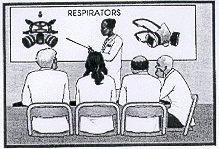
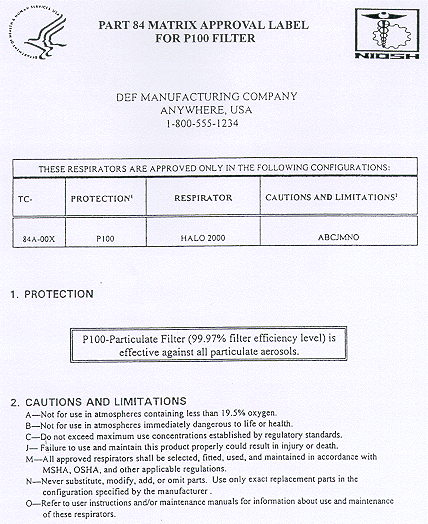
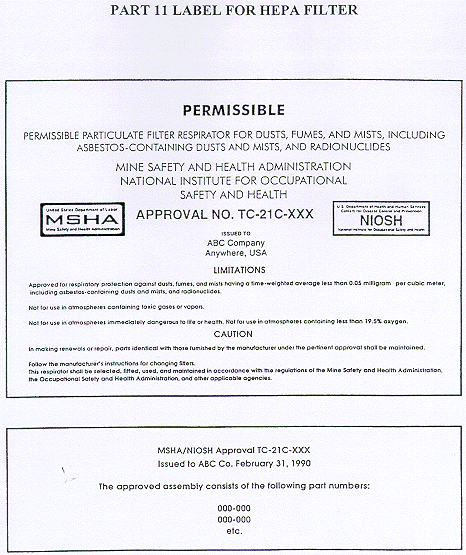
Respiratory Protection Q: What is a respirator? A: A respirator is a protective facepiece, hood or helmet that is designed to protect the wearer against a variety of harmful airborne agents. Q: When is the use of respirators required? A: OSHA's respirator standard, 29 CFR 1910.134, requires the use of respirators to protect employees from breathing contaminated and/or oxygen-deficient air when effective engineering controls are not feasible, or while they are being instituted. Several other OSHA regulations also require the use of respirators. Q: Can any respirator be used? A: No, respirators shall be selected on the basis of hazards to which the worker is exposed (i.e., particulates, vapors, oxygen-deficiency, or combination). Also, OSHA requires the use of certified respirators. Q: Who certifies respirators? A: The National Institute for Occupational Safety and Health (NIOSH). Q: How can a certified respirator be recognized? A: On July 10, 1995, 30 CFR Part 11 certification procedures were replaced by 42 CFR Part 84 procedures. Under the 30 CFR Part 11 approval system, manufacturers were required to mark cartridges and filters with an abbreviated label that included a NIOSH/MSHA approval number ("TC number"). Under the 40 CFR Part 84 approval system, cartridges and filters are no longer marked with a "TC number". Instead, they are marked with "NIOSH", the manufacturer's name and part number, and an abbreviation to indicate the cartridge (e.g., OV, CL) or filter (e.g., N95, P100) type. All cartridges and filters are to be supplied with a matrix approval label, usually as an insert in the box. This label shows the NIOSH approved configurations and includes the "TC number", component parts, and cautions and use limitations.
Q: Which class of Part 84 respirator should be used where a particular OSHA standard requires the use of a respirator with HEPA filtration? A: Where workers are exposed to a hazard that would require the use of a respirator with HEPA filtration, the appropriate class of respirator under the 42 CFR Part 84 certification is the Type 100 (N100, R100, or P100).
Q: Why is a formal respirator program needed? A: A respirator program increases the chances of using a respirator correctly. A respirator will only protect if it is used correctly. Also, OSHA requires a number of written elements for all respiratory protection programs. Q: Who is in charge of the respirator program? A: The program must be administered by a trained program administrator who is qualified and knowledgeable in respiratory protection to run all aspects of the program.
Q: What do employees need to know about the respirator program? A: Employers must establish and implement a written respiratory protection program with worksite-specific procedures and elements for required respirator use. The provisions of the program include procedures for selection, medical evaluation, fit testing, training, use and care of respirators. Q: How is the proper respirator size determined? A: Proper respirator size is determined through a fit test. Employees using negative or positive pressure tight-fitting facepiece respirators must pass an appropriate fit test using the procedures detailed in OSHA's respirator standard.
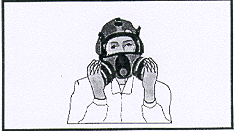
Qualitative Fit Test Chamber Q: Can employees check the fit of their own respirator? A: Yes, employees using tight-fitting facepiece respirators are required to perform a user seal check each time they put on the respirator. They must use the procedures in Appendix B-1 of 29 CFR 1910.134 or procedures recommended by the respirator manufacturer that the employer demonstrates are as effective as OSHA's procedures. Note that a fit test is a method used to select the right size respirator for the user. A user seal check is a method to verify that the user has correctly put on the respirator and adjusted it to fit properly, as illustrated below.
User Seal Check: worker covering inlet and inhaling Q: When is respirator fit testing required? A: Fit testing of all negative or positive pressure tight-fitting facepiece respirators is required prior to initial use, whenever a different respirator facepiece is used, and at least annually thereafter. An additional fit test is required whenever there are changes in the user's physical condition that could affect respirator fit (e.g., facial scarring, dental changes, cosmetic surgery, or an obvious change in body weight). The employer must be fit tested with the same make, model, style, and size of respirator that will be used. Q: What can be done if an employee has a very small face and has trouble being fit tested for a respirator? A: Manufacturers make several different sizes. Respirators may also vary in size from manufacturer to manufacturer. Users may be able to get a better fit by trying a respirator made by another manufacturer. In some cases, the use of powered air-purifying respirators may be appropriate. Employers must help employees find a suitable respirator. Q: Must employees see a doctor before they use a respirator? A: The employer must provide a medical evaluation to determine the employee's ability to use a respirator before the employee is fit tested or required to use the respirator in the workplace. Not all workers must be examined by a doctor. A physician or other licensed health care professional must perform the medical evaluation using the medical questionnaire contained in Appendix C of 29 CFR 1910.134 or an initial medical examination that obtains the same information.
Q: What maintenance and care is required for respirators?
Q: Can a respirator be used by more than one person? A: Disposable respirators cannot be disinfected, and are therefore assigned to only one person. Disposable respirators must be discarded if they are soiled, physically damaged, or reach the end of their service life. Replaceable filter respirators may be shared, but must be thoroughly cleaned and disinfected after each use before being worn by a different person, using the procedures in Appendix B-2 of 29 CFR 1910.134, or equally effective procedures recommended by the manufacturer. Q: How long can a particulate respirator be used before it must be discarded? A: Respirators with replaceable filters are reusable, and a respirator classified as disposable may be reused by the same worker as long as it functions properly. All filters must be replaced whenever they are damaged, soiled, or causing noticeably increased breathing resistance (e.g., causing discomfort to the wearer). Before each use, the outside of the filter material should be inspected. If the filter material is physically damaged or soiled, the filter should be changed (in the case of respirators with replaceable filters) or the respirator discarded (in the case of disposable respirators). Employers must develop standard operating procedures for storing, reusing, and disposing of respirators that have been designated as disposable and for disposing of replaceable filter elements. Q: What is the proper way to store a respirator that is used routinely? A: Respirators must be stored to protect them from damage, contamination, dust, sunlight, extreme temperatures, excessive moisture, and damaging chemicals. They must also be packed or stored to prevent deformation of the facepiece and exhalation valve. A good method is to place them in individual storage bins. Keep in mind that respirator facepieces will become distorted and the straps will lose their elasticity if hung on a peg for a long time. Check for these problems before each use. Storing the respirator in a plastic sealable bag after use is not considered a good practice. The respirator may be damp after use and sealing prevents drying and encourages microbial growth. If plastic bags are used, respirators must be allowed to dry before storage. Q: Are there any additional requirements for the storage of emergency respirators? A: Yes, emergency respirators must be kept accessible to the work area and stored in compartments or in covers that are clearly marked as containing emergency respirators, and stored in accordance with any applicable manufacturer instructions. Q: What are the employer's obligations when respiratory protection is not required but employees wear respirators on their own accord? A: The employer must implement those elements of the written respiratory protection program necessary to ensure that any employee using a respirator voluntarily is medically able to use that respirator, and that the respirator is cleaned, stored, and maintained so its use does not present a health hazard to the user. Also, employers must provide the voluntary respirator users with the information contained in Appendix D of 29 CFR 1910.134. Q: Is training required before a respirator is used? A: Yes, training must be provided to employees who are required to use respirators. The training must be comprehensive, understandable, and recur annually, and more often if necessary. This training should include at a minimum: - Why the respirator is necessary and how improper fit, use, or maintenance can compromise its protective effect - Limitations and capabilities of the respirator - Effective use in emergency situations - How to inspect, put on and remove, use and check the seals - Maintenance and storage - Recognition of medical signs and symptoms that may limit or prevent effective use - General requirements of OSHA's respirator standard, 29 CFR 1910.134 Q: What can be done if employees find it difficult to talk with co-workers when wearing a respirator? A: Some respirators may interfere with speech more than others. Devices that enhance speech communication are available. Ask your program administrator if there are alternatives. Q: If employees have a beard or moustache, is their respirator still effective? A: Tight-fitting facepiece respirators must not be worn by employees who have facial hair that comes between the sealing surface of the facepiece and the face or that interferes with valve function. Respirators that do not rely on a tight face seal, such as hoods or helmets, may be used by bearded individuals. Q: Can employees wear glasses while wearing a respirator? A: Yes, but if an employee wears corrective glasses or goggles or other personal protective equipment, the employer must ensure that such equipment is worn in a manner that does not interfere with the seal of the facepiece to the face of the user. Kits are available from all respirator manufacturers that allow the mounting of prescription lenses inside the respirator. Q: If employees get a rash when they wear a respirator with a latex seal, how can this be prevented? A: Users might have an allergy or sensitivity to the latex or its additives used in the manufacture of some respirators. Changing to a respirator using a silicone-based compound for the face seal, or a respirator that doesn't have a face seal (like a hooded PAPR) may solve the problem. Employers must help employees find a respirator that does not cause this problem. If you need help developing a respiratory protection program, call EHSO at 770-645-0788!
Ways to save money AND help the environment:
Protect your health with these:
|

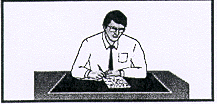
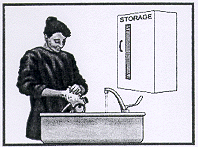 A: The employer must provide for the cleaning and disinfecting, storage, inspection, and repair of respirators used by employees according to the procedures in 29 CFR 1910.134.