
Translate this page to any language by choosing a language in the box below.
The annual records must be retained for at least three years after the facility drops below the required reporting quantities.
An annual document log is required for any facility that uses or stores at least 45 kg (99.4 lb) of PCBs, or one PCB Transformer, or 50 PCB Capacitors. The document log includes:
 The calendar year covered by the log; and the name, address, and the U. S. Environmental Protection Agency (EPA) identification number of the facilityThe unique number of every manifest for PCBs generated by the facility during the calendar yearFor all manifested PCB waste, unmanifested PCB storage, and any PCBs or PCB Item received from or shipped to other facilities managed by the U. S. Department of Energy (DOE) or the University of California (UC):
  A unique identification number (serial number) for each PCB Article, PCB Container and PCB-Article ContainerPCB weight (kg)Date removed from serviceDate placed in transportDate of disposal, if known
The total number of PCB Articles, PCB-Article Containers, and PCB Containers disposed of or stored for disposal by specific type. The total weight (kg) of PCBs in PCB Articles, PCB-Article Containers, and bulk PCB wasteThe total number of PCB Transformers and the total weight (kg) of PCBs contained in transformers that remain in service at the end of the calendar yearThe total number of PCB Capacitors remaining in service at the end of the calendar yearThe total weight (kg) of any PCBs and PCB Items in PCB Containers remaining in service at the end of the calendar year, including the identification of the container contentsRecords of phone calls and other documentation verifying receipt by the designated storage or disposal facility of PCB waste transported by an independent transporter.
A unique identification number (serial number) for each PCB Article, PCB Container and PCB-Article ContainerPCB weight (kg)Date removed from serviceDate placed in transportDate of disposal, if known
The total number of PCB Articles, PCB-Article Containers, and PCB Containers disposed of or stored for disposal by specific type. The total weight (kg) of PCBs in PCB Articles, PCB-Article Containers, and bulk PCB wasteThe total number of PCB Transformers and the total weight (kg) of PCBs contained in transformers that remain in service at the end of the calendar yearThe total number of PCB Capacitors remaining in service at the end of the calendar yearThe total weight (kg) of any PCBs and PCB Items in PCB Containers remaining in service at the end of the calendar year, including the identification of the container contentsRecords of phone calls and other documentation verifying receipt by the designated storage or disposal facility of PCB waste transported by an independent transporter.
The manufacture of PCBs is prohibited in the United States except for PCBs inadvertently generated under certain conditions. The inadvertent generation of PCBs in a concentration greater than 2 ppm must be reported to the EPA. Additional data must be provided to the EPA whenever:
The total quantity of PCBs in products leaving the manufacturing site in any calendar year exceeds 0.0025 percent of the site's rated capacityThe total quantity of PCBs released to the air from the manufacturing process exceeds 4.54 kg (10 lb) in any calendar yearThe total quantity of PCBs released to the water from the manufacturing process exceeds 4.54 kg (10 lb) in any calendar year.
The data submitted shall include all analytical data and corresponding throughput data for PCBs.
A generator of PCB waste who does not receive a copy of the manifest with a handwritten signature from the designated PCB storage or disposal facility within 35 days of the initial shipment date must immediately contact the transporter and/or designated facility to determine the status of the PCB waste. Such contacts must be documented. Copies of the manifests must be included in the PCB annual log.
A generator of PCB waste who does not receive a copy of the manifest with a handwritten signature from the designated PCB storage or disposal facility within 45 days of the initial shipment date must submit an Exception Report to the EPA Regional Administrator, Region IX. The Exception Report must include:
A legible copy of the manifestA cover letter explaining the efforts taken to locate the PCB wastes and the results of those efforts. The cover letter must be signed by the generator or by the generator's authorized representative.
A One-Year Exception Report must be filed by a generator of PCB waste who (1) does not receive a copy of the Certificate of Disposal within 13 months from the date of removal from service, (2) receives a Certificate of Disposal confirming disposal on a date more than one year after the date of removal from service, or (3) stores PCB waste for greater than one year prior to disposal. The only exception to this requirement is if the generator does not transfer the PCB waste to the disposer within nine months from the date of removal from service, as required. The One-Year Exception Report must include:
A legible copy of the manifest, plus other documentation relevant to the transfer and disposal of the PCB wasteA cover letter, signed by the submitter (generator) or authorized representative, explaining: Date(s) when the PCBs or PCB Items were removed from serviceDate(s) when the PCBs or PCB Items were received by the submitter, if applicableDate(s) when the PCBs or PCB Items were transferred to a designated disposal facilityIdentity of the transporters, storage facilities, and disposal facilities known to be involved with the transactionReason, if known, for the delay in bringing about the disposal of the PCBs within one year from the date of removal from service.
Your company should file a Form 7710-53 with the EPA prior to using, storing, etc. PCBs..
Records documenting the cleanup of spills with high concentrations (500 ppm or greater PCBs) or more than 454 g (1 lb) of PCBs shall be maintained for five years. The records and certification shall consist of the following:
Identification of the source (e.g., type of equipment) of the spillEstimated or actual date and time that the spill occurredDate and time that cleanup was completed or terminated (or the nature and duration of the delay if cleanup was delayed by an emergency or adverse weather)A brief description of the spill location and the nature of the material contaminated, including whether the spill occurred in an outdoor electrical substation, other restricted access location, or non-restricted access areaPre-cleanup sampling data used to establish the spill boundaries, if required because of insufficient visible traces, and a brief description of the sampling methodology used to establish themA brief description of the solid surfaces cleanedThe approximate depth of soil excavation and the amount of soil removedPost-cleanup verification sampling data, a brief description of the sampling methodology, and the analytical technique usedThe estimated cost of cleanup (not required).
Records of the legally required inspections and maintenance history of PCB Equipment, including the name of the person responsible for the inspections and the dates of inspection, must be maintained for at least three years after disposal.
Polychlorinated biphenyls (PCB) spill cleanup and reporting requirements are presented here as guidance. Spills of PCB materials can only be remediated by personnel trained to handle PCB cleanups. Report all spills of PCBs to your Health and Safety / Environmental Staff.
When spills with low concentrations (less than 500 ppm PCBs) and less than 454 g (1 lb) of PCBs occur, all soil within the spill area (visible boundary plus a 1-lateral-ft buffer zone) must be excavated and backfilled with clean soil. Solid surfaces must be double washed/rinsed. (Double wash/rinse means a minimum requirement to cleanse solid surfaces two times with an appropriate cleaning agent. PCBs must be at least 5-percent soluble by weight in the cleaning agent. A volume of PCB-free fluid sufficient to cover the contaminated surface completely must be used in each wash/rinse.The wash/rinse requirement does not mean the mere spreading of the cleaning agent over the surface, nor does the requirement mean a once-over wipe with a soaked cloth.) This action must be completed within 48 hours after the responsible party was notified or became aware of the spill.
When spills with high concentrations (500 ppm or more PCBs) or more than 454 g (1 lb) of PCBs occur, the National Response Center must be notified immediately. The spill area must be cordoned off with at least a 3-ft buffer zone. Warning signs must be clearly visible. The responsible party must document and record the area of visible contamination, noting the extent and center of the visible trace areas. The cleanup of fluid from hard surfaces and the removal of contaminated soil must be initiated (not necessarily completed) within 24 hours after the responsible party was notified or became aware of the spill. If the spill will result in PCB exposure outside the facility, other spill reporting procedures may be required.
The U. S. Environmental Protection Agency (EPA), Region IX, regards soil, asphalt, wood, cement, and concrete as porous materials that absorb PCBs. Where practicable, these materials must be removed when they are within the spill area. The spill boundary must be verified by sampling and analysis. Solid, impenetrable surfaces (e.g., metals and impervious liners) may be decontaminated by a double wash/rinse. All decontamination must be verified by sampling and analysis, using bulk samples for porous materials and wipe samples for impenetrable surfaces.
All concentrated soils, solvents, rags, and other materials resulting from the cleanup of PCBs must be properly stored, labeled, and disposed of as PCB or PCB-contaminated materials. The containers of PCB wastes generated must be free of PCB contamination on all outside surfaces.
The PCB Spill Cleanup Policy for the EPA, Region IX, requires soils to be remediated to background levels (i.e., detection limits), where practicably attainable, of any PCB spill from a source greater than 50 ppm PCBs. In certain cases, the EPA, Region IX, will consider alternative cleanup levels. Cleanup under the Comprehensive Environmental Response, Compensation, and Liability Act (CERCLA) of 1980 allows deviation from the Regional Policy when the reason for deviation is included in the Record of Decision (ROD). The ROD should have the concurrences of the EPA Pesticides and Toxics Branch Chief and the Toxics and Waste Management Division Director.
Spill reports (both verbal and written) must be completed only by the EPD personnel and are required to contain the following information:
Nature of waste or pollutant (i.e., PCB)Quantity of waste or pollutant involvedTime and duration of the incidentCause of the spillEstimated size and location of the affected areaNature of effects (e.g., fish kill, toxic cloud, discoloration of receiving water)Corrective measures taken or planned, and a schedule of these activitiesSpill Prevention Control and Countermeasures (SPCC), and/or contingency plans, in effectPersons notified (include name, organization, date, and times).
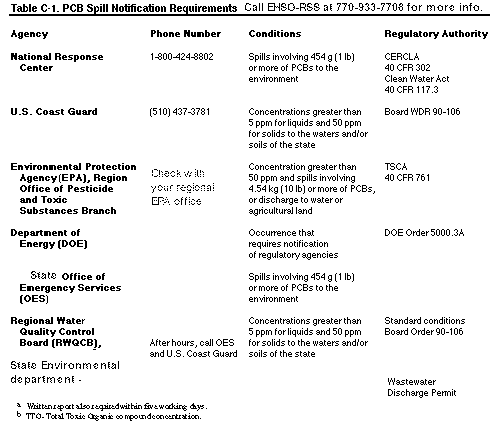
Anumber of agencies are potentially interested in spills of PCBs depending on the spill concentration, quantity, and location. Spill reports must be reported a soon as possible and within the 24-hour legal requirement. Table C-1 (below) summarizes the reporting requirements and notes where written reports are also required.
Ways to save money AND help the environment:
Eat healthier AND save money: Instant Pot Duo Crisp 11-in-1 Air Fryer and Electric Pressure Cooker Combo with Multicooker Lids that Fries, Steams, Slow Cooks, Sautés, Dehydrates
Save water AND money with this showerhead adapter, it lets the water flow until the water is hot, then shuts off water flow until you restart it, ShowerStart TSV Hot Water Standby Adapter
Protect your health with these:
Mattress Dust mite-Bedbug protector, 100% Waterproof, Hypoallergenic, Zippered
Handheld Allergen Vacuum Cleaner with UV Sanitizing and Heating for Allergies and Pet, Kills Mite, Virus, Molds, True HEPA with Powerful Suction removes Hair, Dander, Pollen, Dust,
Immune Support Supplement with Quercetin, Vitamin C, Zinc, Vitamin D3
GermGuardian Air Purifier with UV-C Light and HEPA 13 Filter, Removes 99.97% of Pollutants
5 Stage Air Purifier, Features Ultraviolet Light (UVC), H13 True Hepa, Carbon, PCO, Smart Wifi, Auto Mode, Quiet, Removes 99.97% of Particles, Smoke, Mold, Pet Dander, Dust, Odors
Interesting Reads:
THE PREPPER'S CANNING & PRESERVING BIBLE: [13 in 1] Your Path to Food Self-Sufficiency. Canning, Dehydrating, Fermenting, Pickling & More, Plus The Food Preservation Calendar for a Sustainable Pantry
The Backyard Homestead: Produce all the food you need on just a quarter acre! Paperback
The Citizens' Guide to Geologic Hazards: A Guide to Understanding Geologic Hazards Including Asbestos, Radon, Swelling Soils, Earthquakes, Volcanoes
The Uninhabitable Earth: Life After Warming
Book: The Sixth Extinction: An Unnatural History Paperback
